Proactive ISP Virtual Summit 2026
On May 5 and 6, 2026, Preseem brought together operators, vendors, policymakers, and technologists from across the broadband industry for the inaugural Proactive ISP Virtual Summit, a first-of-its-kind event dedicated entirely to the practical application of AI in ISP operations.
Attendees joined from all over the world, and what they found over two days of sessions wasn’t hype: it was a grounded, honest conversation about where AI is already working in the field, where the gaps remain, and how ISPs of every size can start moving from reactive to proactive.
Below is a session-by-session recap of everything covered. Whether you caught every session live or are just hearing about the summit now, this is your guide to the ideas that defined the event.
Access the Full Recordings
Day 1
Keynote: The Connectivity Crossroads: Why the Next 18 Months Will Define Which ISPs Lead and Which Fall Behind
Futurist and USA Today bestselling author, Ian Khan, opened the summit with a high-level blueprint for navigating the AI era. With global AI investment reaching approximately $200 billion in 2025 alone, Khan argued that the next 18 months represent a defining window where ISPs that act now will pull ahead, while those that wait risk falling permanently behind.
Ian framed the challenge across three dimensions: understanding where the industry stands today, where it’s headed, and what concrete steps operators must take to drive revenue, grow their customer base, and deepen engagement. A key theme was cutting through AI hype: Khan cautioned that many organizations overstate their AI readiness and urged attendees to develop a grounded, cross-industry perspective to separate real capability from inflated claims.

Teresa McGaughey of Calix and Josh Turiano, Chief Innovation and AI Officer at Blue Stream Fiber, offered a candid look at what it actually takes to move AI from experimentation to production. Blue Stream’s journey began in 2024 with a deliberate, democratized approach, treating AI adoption as an organizational change that happened to involve new tools, not a technology project imposed from the top.
Starting with Microsoft Copilot and clear guardrails, the team worked to help employees understand what AI could do for them day to day before layering on more complex use cases. One early win: qualifying every field dispatch order through AI at a cost of just two dollars a month in API tokens, a lighthouse project that earned a 2026 AI innovation award.
Josh noted that the biggest surprise wasn’t technical but organizational: process clarity, decision rights, and workflow hygiene mattered more than model capability. For ISPs evaluating where to start, the message was clear: find repetitive pattern-matching work, automate it, and let the results speak for themselves. AI capabilities are advancing so fast that what seems impossible today becomes table stakes within months.
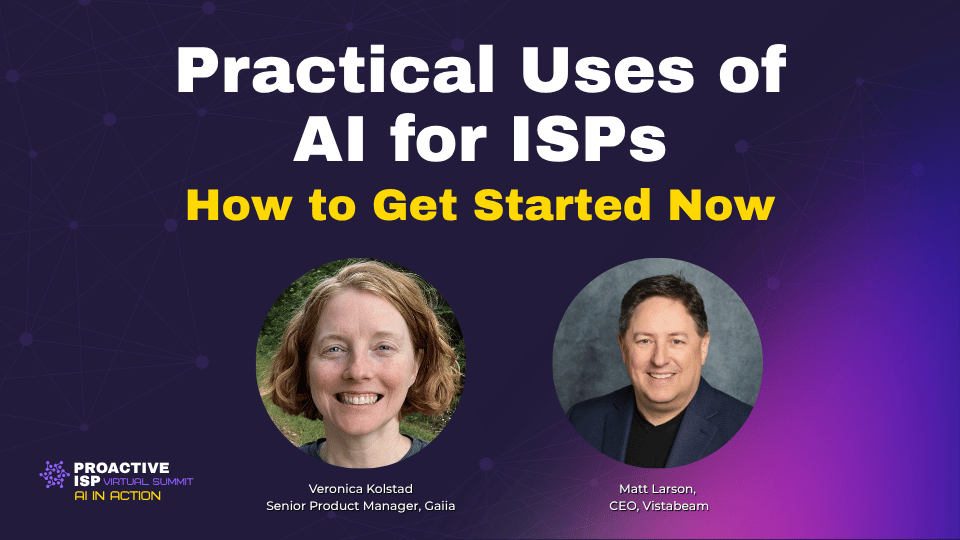
This session brought a practitioner’s lens to AI adoption, i.e. not what’s theoretically possible, but what ISPs with real constraints can do right now. Veronica Kolstad from gaiia and Matt Larsen, CEO of Vistabeam, shared how operators can begin with the basics: identifying repetitive, time-consuming tasks, using AI to automate or augment them, and building confidence incrementally.
The session emphasized starting with internal use cases, such as drafting communications, summarizing meetings, and processing documentation, before moving to customer-facing or network-critical applications. Veronica and Matt stressed the importance of data quality as a prerequisite: AI will only be as good as the information fed into it.
For smaller ISPs without dedicated AI teams, the advice was practical: use commercially available tools thoughtfully, establish basic governance policies early, and treat early wins as proof points that build organizational buy-in. The path to AI isn’t a single leap; it’s a series of small, compounding steps.
Andrii Konovalenko of QueSee AI and Matthew Stooke, AI Data Scientist at Wisper, presented two sides of the same retention challenge and offered a compelling ROI argument before diving into the mechanics. For example, for an ISP with 10,000 subscribers and just 1% monthly churn, even saving 5% of those controllable cancellations translates to around $50,000 in recovered annual revenue. At a 5x enterprise multiple, that’s $300,000 in preserved business value.
The session then walked through how Wisper built an end-to-end churn prediction model drawing on router performance data, radio telemetry, support ticket history, billing patterns, and FCC competitor availability by ZIP code. No single data source is sufficient; the churn signal emerges from combining them all.
The model maintains a “top 100” at-risk list, which has proven five times more accurate than random outreach. Critically, the customers flagged are typically experiencing real service problems, making them the easiest to retain through proactive intervention. The key insight: most customers who cancel never called in, making reactive retention strategies fundamentally limited without predictive tooling.
NEW: Preseem/QueSee Integration
Preseem co-founders Scot Loach and Dan Siemon closed out Day 1 with a technical deep-dive into why building AI agents in the ISP space is uniquely difficult, and what the path forward looks like. The core challenge: ISP networks are inherently heterogeneous. Most operators run equipment from five or more vendors, spanning multiple access technologies, accumulated through years of evolution and acquisitions.
This complexity makes it extremely difficult for LLMs to reason reliably about network state. The same metric name can mean different things across vendors; firmware quirks vary by model; context that’s obvious to an experienced technician is opaque to a general-purpose AI. The solution isn’t more data, it’s abstraction.
Scot and Dan argued that the “missing layer” is a normalized, ISP-specific data layer that translates raw, heterogeneous telemetry into a standardized format that AI agents can reason about reliably. Just as good tooling hides complexity from new employees so they can be productive faster, good AI architecture must hide network complexity from LLMs so they can operate reliably. ISPs that invest in this abstraction layer now will be best positioned to benefit from agentic AI as it matures.
Day 2
Industry Address: AI Opportunities and Challenges for Rural Broadband Providers
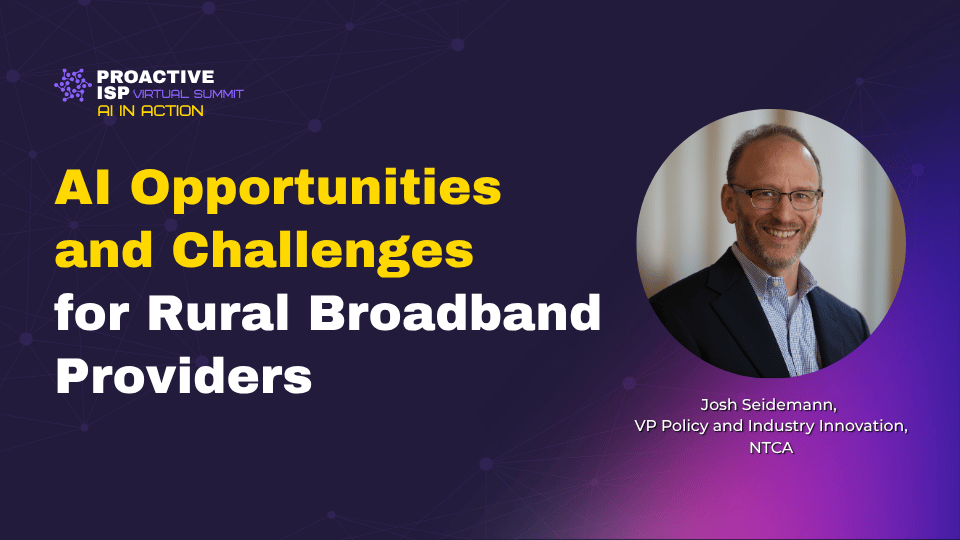
Joshua Seidemann, VP of Policy and Industry Innovation at NTCA, opened Day 2 with a sweeping look at AI’s potential for rural broadband providers and the communities they serve. NTCA represents approximately 850 locally operated telecom providers across 44 US states, serving 7% of the US population across nearly 30% of the nation’s landmass at densities of just 8 customers per square mile.
Joshua framed AI not as a threat but as potentially the most powerful tool ever developed for closing the rural-urban divide. He opened with a vivid scenario: a technician’s 2 a.m. emergency call about a downed fiber line, and how an AI-enabled network management system could have predicted the failure, rerouted traffic automatically, and queued a work order with GPS coordinates and a parts list, all before the first customer noticed an outage.
He then covered AI’s applications across customer operations, cybersecurity, predictive maintenance, personalization, and community sectors like healthcare, agriculture, and education. His core framework: start with the use case, then evaluate the tool—not the other way around.
Claude Aiken, Chief Strategy and Legal Officer at Nextlink, and Nathan Stooke, founder and CEO of Wisper, brought a grounded, operator-to-operator perspective to AI adoption in rural and regional ISPs.
A key framework from the session was separating “individual AI” (tools employees use personally) from “system AI” (automated workflows embedded in operations). Each requires different policies, different governance, and different success metrics; conflating them creates confusion that slows adoption.
Both operators described specific system AI use cases already in production: churn likelihood scoring based on 50+ data points, automated alarm correlation across heterogeneous infrastructure, AI-assisted dispatch and scheduling, and call review tools that evaluate customer interactions for quality. Nextlink is also tracking Starlink’s competitive presence by ZIP code as an input into retention modeling.
A recurring theme: employees who resist AI often don’t realize they’re already using it. Once one person brags about how much easier their job has become, adoption tends to accelerate naturally.
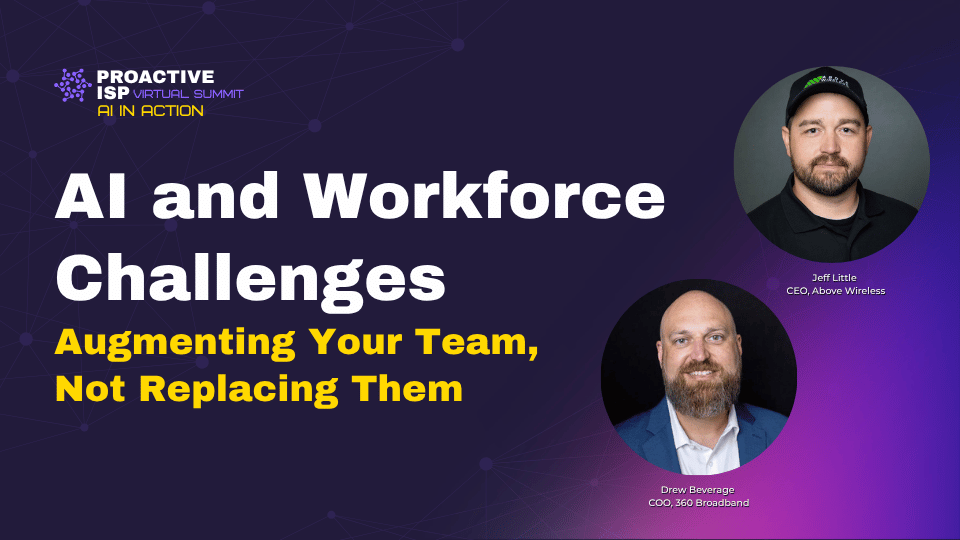
Jeff Little of Above Wireless and Drew Beverage, COO of 360 Broadband, delivered one of the summit’s most practical sessions: a field-level look at how AI is already changing the day-to-day experience of ISP construction and operations teams.
Jeff described AI as operating across two lanes: “office intelligence” that structures information and drafts documentation, and “field execution” support that reduces the time crews spend chasing statuses, locating access codes, and reconstructing what happened. With AI synthesizing daily reports and managing the information loop across multi-phase builds, managers are working roughly half as hard on administrative coordination. This frees them to focus on safety, inspections, and human judgment calls.
Drew added that 360 Broadband uses AI-driven analysis of network and customer experience data to identify where agents need targeted coaching, and turned on IVR automation that removed 800 calls a month from the support queue. His insight on hiring: AI enables operators to prioritize emotional intelligence over encyclopedic technical knowledge, because the knowledge layer can now be handled by tools.
Both speakers emphasized that how you introduce AI to your team matters as much as the tools themselves, and framed it as removing the drag, not the dignity, from workers’ jobs.
Bjørn Ivar Teigen Monclair of Cujo AI and Hal Ponton, Chief Architect at Voneus Broadband, delivered a candid session on what separates chatbots that actually help customers from those that frustrate them. Their shared thesis: the unlock for ISP support AI isn’t better LLMs, it’s better data access.
A chatbot without real-time visibility into a customer’s connection, their area’s network status, and their service history will fall back on generic FAQs no matter how sophisticated the underlying model. Hal illustrated the failure mode vividly: when Voneus fed raw network telemetry to an AI without proper context, it confidently instructed customers to “rotate their houses to face northwest” to resolve a line-of-sight interference issue. The lesson: AI needs to know which solutions are actually viable, not just what the data suggests.
Both speakers emphasized pre-filtering data before it reaches the LLM, discarding irrelevant signals and highlighting what actually matters, for both accuracy and cost efficiency. Voneus now requires its AI to cite internal documentation for every recommendation it makes, creating a traceable, auditable decision trail. The same approach works when AI is used as a co-pilot for frontline agents, helping junior staff access institutional knowledge that previously only senior engineers held.
Benny Fallica, Business Development Manager at Nokia, and Ryan Grewell, Chief Innovation Officer at Nextlink, tackled one of the most tangible cost centers in ISP operations: the unnecessary truck roll.
Their opening point set the tone: AI won’t eliminate truck rolls entirely, nor should it. When fiber gets physically damaged, field crews have to go. The goal is eliminating avoidable dispatches: the ones triggered by congestion patterns that could have been resolved remotely, device issues that could have been caught earlier, or installations done incorrectly the first time.
Nokia’s framework for AI in this context runs from signal correlation (detecting anomalies in the network noise), to anomaly prediction, to installation validation (using image analysis to confirm cabling is done correctly before a crew leaves the site). Ryan described Nextlink’s AI-assisted 811 “call before you dig” automation, which has measurably reduced fiber cuts by improving impact analysis and informing future network design.
The broader principle: the best time to avoid a truck roll is before the failure happens, and AI is most valuable when applied to prevention, not just reaction. Human operators remain in the loop for high-impact decisions; AI compresses the investigation time so that judgment is applied where it’s actually needed.
Find Issues Before Your Customers Do
Ken Garnett, founder of Beyondchat.ai, and Larry Weidig, Technical Product Manager at Sonar Software, closed the summit’s main programming with a forward-looking session on the shift from AI tools to AI agents. Their central distinction: chatbots answer questions and return to standby; agents pursue goals. A chatbot responds to “Is my service down?” An agent asks “Why is this subscriber experiencing trouble, and can I fix it before they call?”
The session walked through what an agentic support workflow looks like in practice: a signal arrives, the system triages the issue, runs diagnostics, reaches out proactively to the subscriber, and, if human judgment is needed, delivers a fully assembled escalation with no cold handoff and no re-explaining. The human enters at step five, at the moment genuine judgment is required.
Ken and Larry argued this isn’t a feature upgrade, it’s a fundamentally different architecture. The question for operators isn’t which chatbot to deploy; it’s what outcome you’re trying to achieve, and whether your AI is actually completing goals or just answering questions.
Preseem’s Jeremy Austin and Dan Siemon wrapped up the summit with a reflective conversation on what two days of sessions had revealed. Jeremy shared his own evolution on AI—from cautious skepticism to active builder—driven by watching practical possibilities expand rapidly, especially as tool and MCP integrations began to demonstrate what AI could accomplish when connected to real systems.
Dan noted a recurring theme across sessions: AI is already changing who ISPs need to hire, not just what they need to do. If AI handles the institutional knowledge of tier-one support, operators can prioritize emotional intelligence and human judgment over technical encyclopedic knowledge.
The conversation also surfaced a genuine open question: how do ISPs develop Tier 2 and Tier 3 talent if the hands-on Tier 1 ladder is being automated? Dan was candid: nobody knows the full answer yet. But both agreed that operators who empower their teams to use AI tools now, and build internal cultures of experimentation, will be best positioned to adapt as the landscape continues to shift. Dan hinted at upcoming developments from Preseem, including expanded AI capabilities tied to their network intelligence layer.