Find Issues Before Your Customers Do
There’s a version of network operations that most ISPs know all too well.
A subscriber calls in, your support team logs a ticket, and it gets escalated to the NOC. Someone investigates, finds a congested AP or a bad install, and scrambles to fix it. The customer is already frustrated, and the damage is already done.

It doesn’t have to work that way.
The best-run ISPs aren’t just faster at reacting, they’ve stopped reacting altogether. Instead, they’re finding and fixing network issues before subscribers ever notice, let alone pick up the phone.
The Cost of Waiting
Every time a customer calls to report a problem, you’ve already lost ground, and you may have lost trust. Also, depending on how long the issue’s been building, you may have lost the customer entirely.
According to research by Ozmo, a “poor customer service experience can be a top driver of customer churn. 96% of customers leave after just one bad service experience. Customers won’t give you a second chance if your company fails to deliver exceptional service.”
The challenge is that most network operations teams aren’t set up to catch problems early.
Data is scattered across multiple vendor platforms, and there’s no centralized, actionable view of network performance.
Without unified insight, it’s nearly impossible to know which APs are approaching congestion, which backhauls need attention, or whether a degraded experience is coming from the network or a customer’s home — until someone complains.
The result is a team that’s perpetually reactive: chasing escalations, rolling trucks, and firefighting, instead of actually managing the network.
What “Proactive” Actually Looks Like
Proactive network operations isn’t just a philosophy, it’s a practical workflow. And it starts with having the right tools.

When your team has unified, scored visibility into AP health, RF quality, and subscriber capacity across all vendors, the picture changes completely.
Instead of waiting for support tickets to reveal where the problems are, your NOC can generate a weekly list of the worst-performing access points, ranked by customer impact, and start working through them systematically.
The logic is simple: fix the APs that are hurting the most customers, before those customers start calling. It’s the kind of prioritization that’s only possible when all your network data lives in one place.
Finding Issues Before They Escalate
Beyond scheduled maintenance, proactive operations are also about catching issues in real time. That means not just the ones that generate tickets, but the ones that are quietly degrading the experience for subscribers who haven’t complained … yet.
This is where AP and CPE Radio Scores make a real difference. By surfacing congestion, poor RF conditions, and suboptimal installs continuously, your team can identify and prioritize problem areas before they reach a threshold that drives calls and churn.
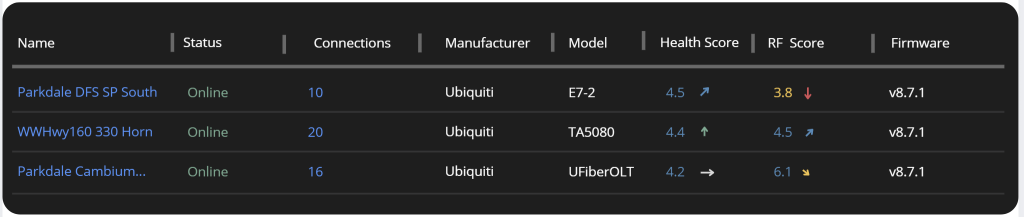
When an AP’s health score starts trending down, you know about it. When a CPE install looks marginal, you can flag it for re-optimization. When backhaul utilization climbs, you can plan capacity before it breaks.
The alternative — waiting for subscribers to report symptoms — is both more expensive and more damaging to retention. By the time a customer calls, the issue has typically been building for a while. And for every customer who calls, there are others who simply switch providers.
Fewer Escalations, Better Use of Your Team
There’s another dimension to proactive operations that’s easy to overlook: what it does for your team’s time and focus.
When support doesn’t have visibility into whether an issue is on your network, in the customer’s home, or affecting multiple subscribers on an AP, the default is to escalate. It’s the safe call. But it pulls your NOC engineers into conversations they shouldn’t need to have, interrupting higher-value work to answer questions that the data could answer automatically.
When each team — support, NOC, field techs — has access to the right level of visibility for their role, escalations become rarer and more meaningful. Support can resolve in-home issues without involving engineering. Field techs can pull diagnostics on-site without calling, and the NOC gets cleaner escalations with better context when they do come in.

AirBridge Broadband put it simply: “We’ve been able to reach out to customers before they even knew they had a problem. They’re impressed.” That’s what happens when your team is ahead of the network instead of behind it. And the numbers back it up: for example, AirBridge saw a 20% reduction in service calls and truck rolls after shifting to proactive network operations.
From Firefighting to Network Management
The shift from reactive to proactive isn’t just operational, it’s cultural. When your engineering team’s calendar is no longer dictated by escalations, they can focus on the work that actually moves the network forward: upgrading infrastructure, expanding capacity, and improving the overall subscriber experience.
That’s the real value of proactive operations. Not just fewer support calls, though you’ll see those drop. Not just lower truck roll costs, though you’ll see those too. It’s the ability to run a better network, one where problems get caught and fixed quietly, subscribers get consistent service, and your team spends its time on work that matters.
The phone will always ring sometimes. But with the right visibility, it doesn’t have to ring as often, and when it does, your team will already know why.
Take a Preseem Product Tour
Frequently Asked Questions
- What does “proactive network operations” actually mean in practice? It means identifying and resolving network issues — congested APs, degrading RF conditions, poor installs, backhaul strain — before they generate support tickets or customer complaints. In practice, this looks like weekly maintenance cycles where your NOC reviews ranked lists of underperforming access points and addresses them systematically, rather than waiting for escalations to dictate the work.
- How do AP and CPE Radio Scores work? Preseem collects RF and performance data from your network equipment and translates it into simple health scores for every AP and CPE device. These scores surface which devices are performing poorly, ranked by severity and customer impact, so your team knows exactly where to focus without having to manually dig through raw data across multiple vendor systems.
- Does this work across multiple vendors and access technologies? Yes, Preseem supports multi-vendor, multi-access environments, such as fixed wireless and fiber, through a single platform. Whether your network runs Cambium, Ubiquiti, Mimosa, MikroTik, Calix, or others, the scoring and visibility are normalized across all of them.
- What if our support team doesn’t have deep technical knowledge? That’s part of the point. Preseem is designed to give each team — support, NOC, field techs — the right level of visibility for their role, without requiring deep technical expertise at every tier. Support agents can determine whether an issue is network-related or customer-side without needing to understand RF engineering. The data does the heavy lifting.
- How does this reduce truck rolls specifically? Truck rolls are often dispatched because the support team can’t confidently determine where a problem originates. When agents can see in seconds whether an issue is on your network, in the customer’s home, or affecting multiple subscribers on an AP, they can make better decisions, and dispatch trucks only when there’s a confirmed field problem, not as a fallback for uncertainty.