
Find and Fix Issues Before Your Customers Leave
Most ISPs don’t realize they have a churn problem until customers have already left. By the time a subscriber cancels, they’ve likely been frustrated for weeks—shopping competitors, researching alternatives, and mentally checking out.
Whether they’re experiencing wireless signal issues, fiber ONT problems, or network congestion, the results are the same: degraded performance that drives them to competitors.
Regional ISPs need network and customer context to identify at-risk customers before they reach that breaking point, turning churn prevention from reactive firefighting into strategic retention.
Key Takeaways
For ISPs looking to reduce customer churn and improve retention:
- Silent churn is the real threat: 97% of customers leave without complaining, they just disappear after weeks of frustration, making reactive approaches ineffective.
- Acquiring customers costs 5-25x more than keeping them: Churn prevention isn’t just about satisfaction, it’s fundamental to profitability and sustainable growth.
- Multi-vendor complexity hides churn risk: Without a unified view across different equipment and access technologies, identifying at-risk customers becomes nearly impossible.
- Churn risk falls into two categories: Customer premise issues (poor installations, undersized link rates, faulty ONTs) and infrastructure problems (overloaded APs, backhaul bottlenecks, PON splits exceeding capacity, fiber cuts)—these require different solutions.
- Poor installations are double risks: Customers who can’t achieve their plan speeds face both immediate churn risk and lost upsell opportunities. Prioritize fixing these based on customer value.
- Platform completeness is critical: The value comes from comprehensive coverage across your network; incomplete visibility means hidden churn risk.
Subscriber Churn: The Silent Problem
No matter what business you’re in, customer churn is inevitable.
We’re going to go out on a limb and say that no company in history has managed to retain every customer they’ve ever gained, such is the beauty of healthy competition and consumer freedom of choice.
Regional ISPs know this all too well, with intense competition from other local operators, cable companies, nationwide fiber deployments from large telcos, and upstart satellite providers (some of whom are newly flush with millions in government funding), all threatening to lure customers away with a combination of faster plans and lower rates.

However, though some level of churn may be as inescapable as death and taxes, that doesn’t mean regional operators can’t or shouldn’t do anything about it.
In fact, focusing on how to reduce customer churn can have an outsized impact on the bottom line. As Ookla has noted, “industry studies consistently show that acquiring a new customer costs 5 to 25 times more than keeping an existing one.”
Here’s the problem, though. By some estimates, a whopping 97% of users churn silently. No angry calls to the support line, no scathing posts on social media, they just … leave.
As stated in this article from 180ops, “the problem isn’t churn itself—it’s failing to recognize which churn is avoidable, which customers are at risk, and how to intervene before it’s too late.”
For regional ISPs running multi-vendor, multi-access networks, identifying churn risk is even harder.
When your network spans multiple equipment vendors, access technologies, and management systems, achieving a unified view of the customer experience becomes nearly impossible. Information lives in silos across vendor-specific tools, making it difficult to find which customers are struggling and why.
In this article, we’ll show you how Preseem’s platform approach solves this problem, giving you the network and customer context needed to proactively identify at-risk subscribers and retain them.
Stop Losing Customers to Starlink
You Need Unified Visibility Across Your Multi-Vendor Network
Is your ISP using many different systems, each with its own interface, data model, and expertise requirements? Then you’ll know this makes it nearly impossible to identify churn risk patterns, especially when problems span different vendors or access technologies.
The solution: Instead of logging into separate systems for each equipment vendor or access technology, Preseem provides a unified view that normalizes data across your entire infrastructure.

As an example, for fixed wireless networks, Preseem tracks latency, link rates, signal quality, and RF environment conditions. For fiber networks, we monitor ONT performance, PON utilization, optical signal levels, and more. All of this in one UI, with two years of historical data saved so you can identify trends or one-off issues.
This means your teams don’t need to know each vendor’s specific tools and terminology inside and out. Instead, they can focus on proactively monitoring the network to identify issues that are elevating your customer churn risk.
Use Data to Identify At-Risk Customers
So, how does having a unified platform like the one described above help with identifying churn risk? It’s all about the data.
There are two churn risk categories: subscriber-level (issues at the customer’s location) and infrastructure-level (network-wide problems, e.g. oversubscribed APs).
If you have a platform that includes subscriber information, not just fixed wireless or fiber metrics, and that normalizes data across vendors, then you can start proactively identifying churn risk.
Here are a couple of quick, simple examples from Preseem.
Fixed Wireless
On a fixed wireless network, one way to identify infrastructure-level churn risk is with AP Health scores. These take into account three potential bottlenecks: airtime contention, the number of CPE radios attached, and the RF environment.
Preseem color-codes health scores for instant assessment. Green means good, blue is OK, yellow is a warning, and red is critical.
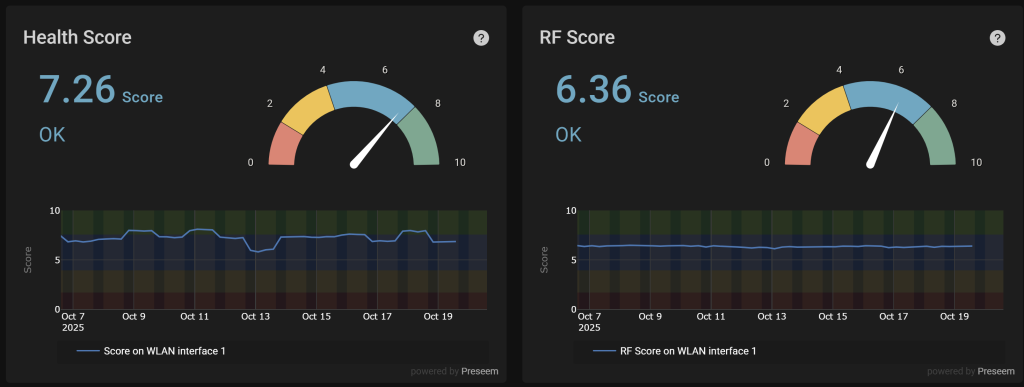
Any access point showing yellow or red for the above or other scores may indicate churn risk for every customer connected to it.
You don’t need deep technical expertise in RF engineering or wireless networking to identify these problems, and you don’t have to log into multiple systems to check all your APs.
Now you can prioritize APs in yellow or red, proactively fix any issues or reach out to customers on those towers, and prevent unnecessary support calls and silent churn.
For another quick example, watch this video clip from one of our recent webinars to see how our hosts find 194 at-risk customers in a network with 12,000 CPEs in seconds, simply by filtering on Preseem’s RF Score.

Fiber
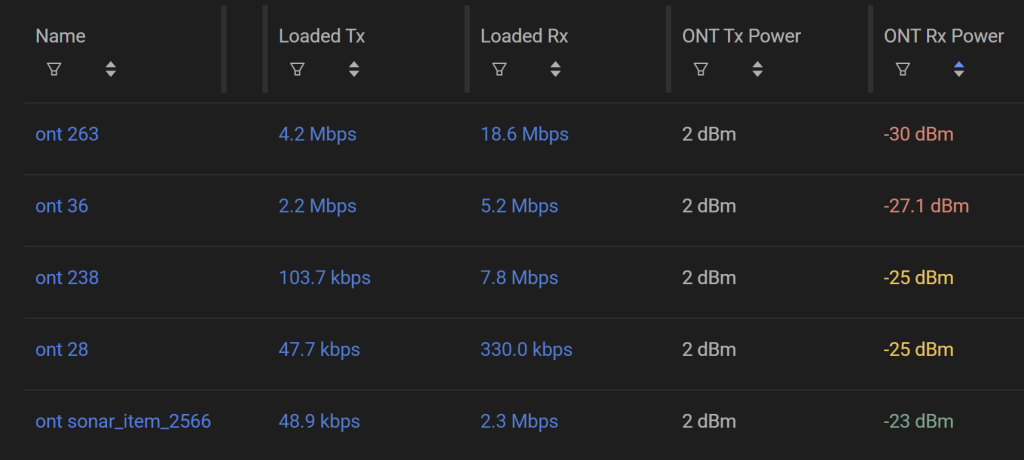
On fiber networks, water intrusion and failing splitters can cause slow signal loss that goes undetected until customers churn. Without historical data, your team has to log into multiple vendor tools and run time-consuming manual tests, reacting only after a subscriber complains.
Preseem eliminates the guesswork by providing two years of historical light level data across all major vendors, enabling your team to find degradation trends before they start hurting your bottom line.
Sort, Export, and Quantify
The real power comes from combining views like those shown above into actionable lists. Data can be exported to create a custom report of all customers connected to APs with health scores in the warning or critical range, for example.
Or export a list of customers whose link rates are below their plan speeds to isolate any installation-related churn risks. You could then cross-reference these technical indicators with customer tenure and plan value to prioritize which risks to address first.
These metrics support investment decisions with clear ROI calculations. For example, an AP health issue affecting 50 customers with an average ARPU of $75/month would represent $45,000 in annual revenue at risk. At that point, the business case for addressing that infrastructure issue becomes immediately clear.
Empower Your Teams to Root Out Risk
Having visibility into churn risk only creates value when your teams can act on it. Enable each team to operate more effectively by giving them the context they need without requiring deep technical expertise across multiple vendor systems.
For Network Operations teams: Network Ops can shift from reactive fire-fighting to proactive management. Weekly reviews of infrastructure health scores identify access points or PON ports in warning or critical zones before they generate support calls.
Network Operations can also operate at a higher business level, making decisions about capacity expansion, load balancing, and infrastructure investment based on comprehensive data about customer impact and revenue at risk.
The platform becomes a foundation for answering questions from other business teams about network capacity, service quality, and expansion priorities. Learn more here.

For Field Operations teams: Monthly reviews of installation quality identify customers whose installations are performing below potential. Field teams can proactively schedule site visits to optimize wireless installations, test fiber signal levels, or replace aging ONTs before they fail.
Framing these as proactive service optimization (“We noticed your installation could be performing better, and we’d like to optimize it at no charge”) turns potential churn situations into positive customer experiences that build loyalty.
For Management: The platform provides visibility into churn risk metrics at the organizational level. What percentage of customers are connected to infrastructure in Warning or Critical zones? How many customers have installations that can’t support their plan speeds? What’s the total monthly recurring revenue at risk from these technical issues?
"Stop Chasing Rabbits, Start Solving Problems"
Move From Reactive to Proactive
The traditional ISP operating model is reactive. Wait for customers to call, try to fix the problem, hope they stay. This approach fails because by the time customers call, they’re often already researching alternatives.
Also, without a unified view across different equipment and access technologies, you’re always playing catch-up, trying to piece together what’s happening from multiple vendor systems.
A proactive approach flips the script.
- Instead of waiting for complaints, you identify technical issues ahead of time.
- Rather than treating every support call as a one-off, you recognize patterns indicating infrastructure problems.
- Instead of wondering why customers in an area are churning, you see they’re all connected to overloaded infrastructure.
Silent churn stops being silent when you have a platform that gives you the network and customer context you need. Regional ISPs need to win by providing better service, support, and agility in ways Tier 1 providers can’t. Preseem gives you the platform foundation to make that possible, not by adding another tool to your stack, but by creating a unified layer that brings commonality to your complex multi-vendor network.
How Vistabeam Slashed Support Calls by 50%
Ready to stop silent churn? The customers you’re losing tomorrow are struggling with performance issues today. Preseem’s platform gives regional ISPs the network and customer context they need to identify at-risk customers and retain them before they start shopping around. Book a demo to see how Preseem can transform your approach to churn prevention.