Stop Guessing Where to Invest Next
Network Operations Leaders at regional ISPs usually turn to capacity planning tools because they’re tired of the following situations:
- Overselling sites that are already saturated, then firefighting the fallout
- Investing in infrastructure upgrades based on gut feel instead of data
- Answering the same question from Sales every week: “Can we sell more here?”
- Discovering bottlenecks only after subscribers start churning
If any of those sound familiar, the problem likely isn’t your network; it’s the metrics you’re using to plan it.
Traditional capacity planning relies on raw utilization, i.e. how much bandwidth is being consumed. But utilization alone doesn’t tell you whether your subscribers are actually having a good experience. An AP running at 70% utilization can still be delivering terrible latency if airtime is congested, RF conditions are poor, or a handful of devices are monopolizing the link. You can be well within utilization thresholds and still be at risk of losing subscribers.
QoE-based capacity planning changes the frame entirely. Instead of asking “How full is this pipe?”, you ask “How well are my subscribers being served, and where is that about to break down?”
This guide explains what QoE-based capacity planning is, why it produces better decisions than utilization-based approaches, and what it looks like in practice for regional ISPs managing fixed wireless and fiber networks.
What Is QoE-Based Capacity Planning?
QoE-based capacity planning is an approach to infrastructure investment and subscriber growth decisions that uses Quality of Experience metrics — latency under load, airtime efficiency, RF signal quality, retransmission rates, and per-subscriber throughput — rather than aggregate bandwidth utilization as the primary planning signal.
The core idea is that subscriber experience is a more accurate predictor of network strain than utilization percentages. A network can be underutilized in terms of raw throughput but still deliver a poor experience due to congestion at the airtime layer, RF interference, or poorly performing CPE devices.
On the other hand, a network running at high utilization with well-managed QoE traffic shaping can continue to deliver a good experience well past the point where a utilization-only model would flag an upgrade.

Key QoE metrics used in capacity planning:
| Metric | What It Measures | Why It Matters for Capacity |
|---|---|---|
| Airtime utilization | How much of the available RF airtime is being consumed | A more accurate congestion signal than throughput for fixed wireless |
| Latency under load | Round-trip time during peak usage periods | High latency under load is the first sign of a capacity problem subscribers will actually notice |
| Retransmission rate | How often packets must be resent due to errors or congestion | Rising retransmissions indicate airtime or RF stress before throughput degrades |
| RF/CPE score | Signal quality and efficiency of individual subscriber radios | Poor CPE devices degrade AP performance for all subscribers on that sector |
| Subscriber capacity score | Estimated number of additional subscribers an AP can support without QoE degradation | Translates technical metrics into a business-ready planning number |
The practical difference: utilization-based planning tells you a tower is 80% full. QoE-based planning tells you which specific APs are delivering a poor experience right now, which ones have room to grow, and which ones are technically underutilized but operationally stressed.
Why Utilization Metrics Aren’t Enough
Most ISP teams rely on utilization dashboards because that’s what vendor tools provide. But utilization has two blind spots that make it an incomplete planning signal.
Blind spot 1: Airtime ≠ throughput. In fixed wireless networks, the scarce resource is airtime, not bandwidth. An AP can have available throughput headroom while simultaneously running out of airtime, especially with a mix of high- and low-modulation subscribers on the same sector. A utilization graph won’t show you this, but airtime utilization data will.
Blind spot 2: Utilization is an average. Peak-hour congestion is what drives subscriber complaints, and averages mask it. An AP that averages 60% utilization throughout the day may run at 95% during the evening hours, when subscribers are actually online. QoE metrics measured at peak load, particularly latency under load, surface this directly.
The result of relying on utilization alone is a planning model that consistently underestimates where the network is stressed and overestimates where it has room to grow. You end up either overselling congested towers or deferring upgrades that are already needed.
What QoE-Based Capacity Planning Looks Like in Practice
Preseem is a proactive network operations platform built for regional ISPs that puts QoE-based capacity planning into practice. It pulls data across all major vendors and access technologies (Cambium, Ubiquiti, Calix, Adtran, Baicells, and more), and normalizes it into a single view, with QoE metrics tied directly to network topology.
Here’s how the key capabilities map to the capacity planning workflow.
Available Subscriber Capacity Score
Preseem’s Available Subscriber Capacity score converts airtime utilization, subscriber load, and RF conditions into a single number for every AP in your network: the estimated count of additional subscribers that AP can support without degrading QoE.
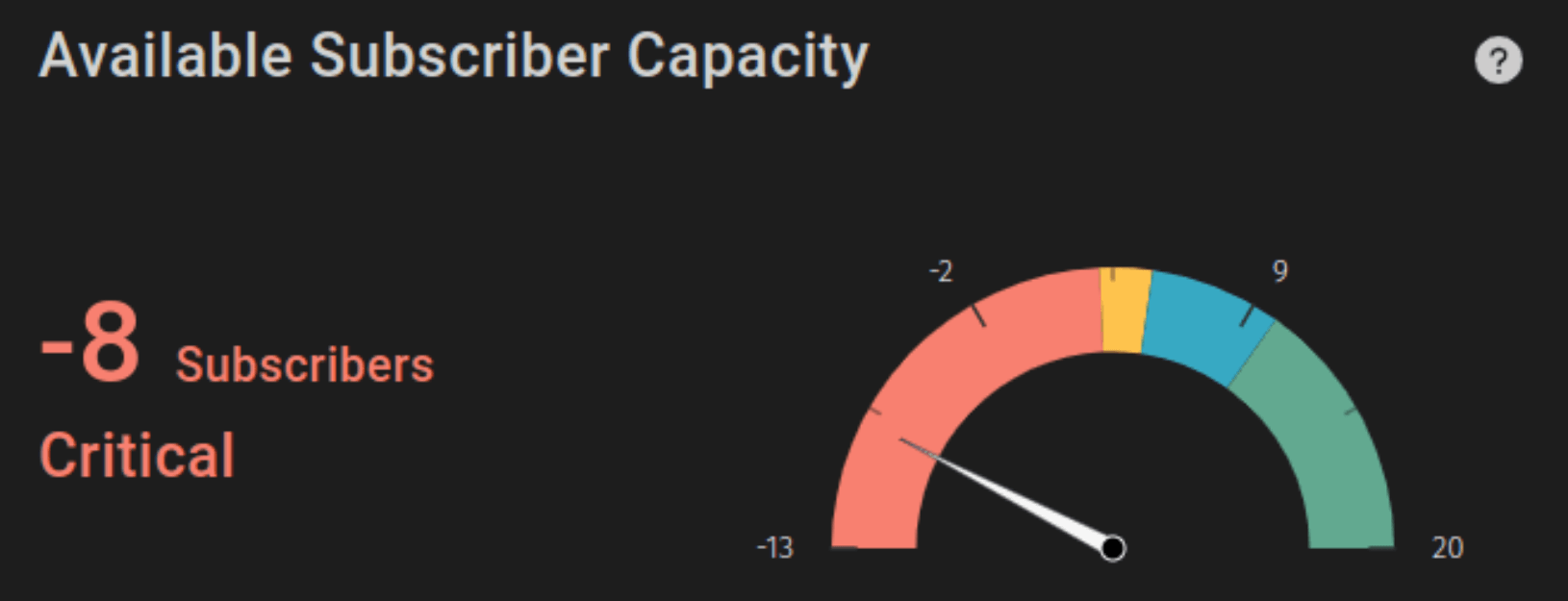
You can sort your entire AP fleet by this score in seconds, instantly seeing which towers have room to sell and which are already at the edge. This gives Sales a data-backed answer to their capacity questions without requiring a multi-day analysis from your team, and it eliminates the overselling problem at the source.
AP Health and RF Scores for Proactive Prioritization
Knowing where capacity is available is only half the picture. The other half is knowing which APs are degrading before subscribers start calling.
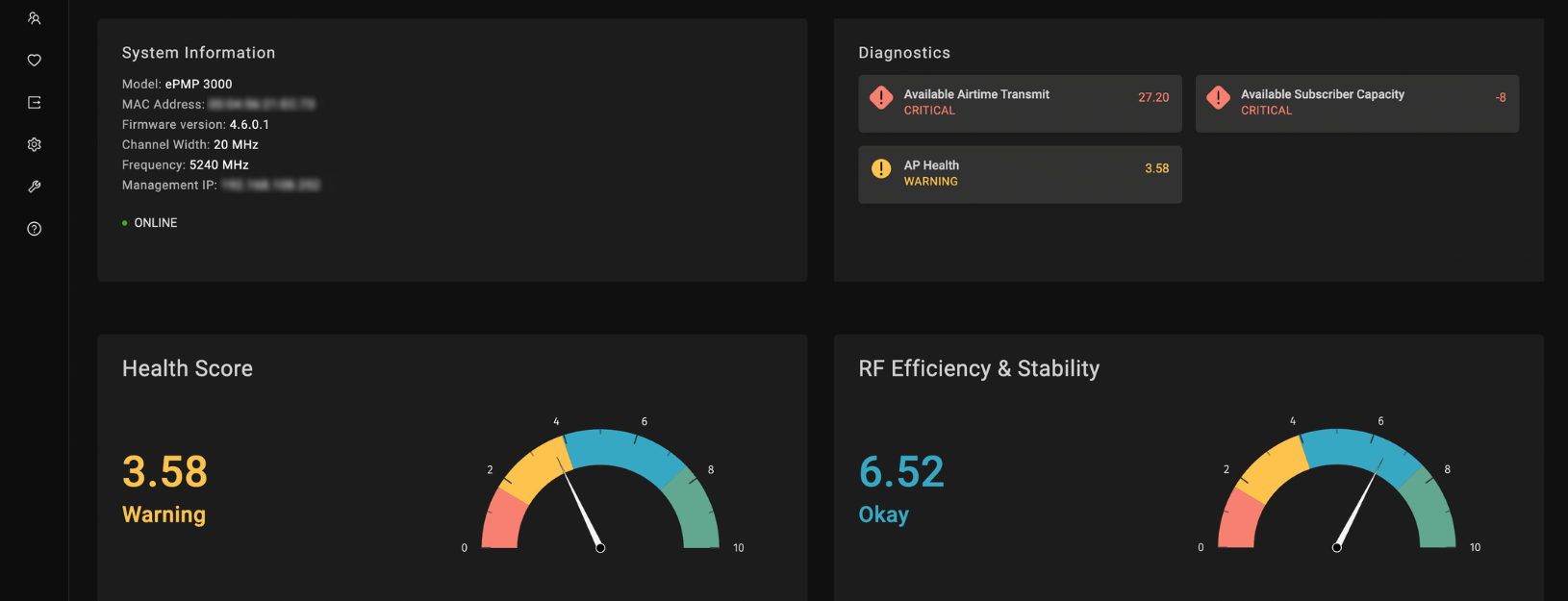
Preseem’s AP Health score and CPE Radio score surface the worst-performing access points across your network automatically, ranked by a combination of RF quality, airtime efficiency, and subscriber experience metrics.
Cross-referenced with subscriber counts, these scores give your team a clear, defensible priority list: Fix the lowest-scoring AP with the most subscribers first.
Cross-Vendor Visibility in One View
For ISPs running multiple vendors across a hybrid fixed wireless and fiber network, capacity planning is complicated by fragmentation. Each vendor platform shows you its own slice of the network in its own format. Getting a unified picture means manual data reconciliation, which doesn’t scale.
Preseem normalizes data across all vendors into a single interface, so your capacity planning workflow is consistent whether you’re looking at a Cambium AP, a Ubiquiti sector, or a fiber PON. As your network evolves — adding fiber, new vendors, or new access technologies — the planning workflow stays the same.
A Repeatable QoE-Based Planning Cadence
Here’s what a practical, ongoing capacity planning rhythm looks like with QoE metrics:
Weekly: Sort your AP fleet by Health score and subscriber capacity. Flag deteriorating APs and assign to the appropriate engineer. This takes minutes, not hours.
Monthly: Review capacity trends across your towers. Use Preseem’s trends to identify sites where subscriber capacity is declining and cross-reference with Sales’ pipeline to get ahead of potential overselling.
Quarterly: Use historical QoE data to build your infrastructure investment case, i.e. which upgrades are justified by subscriber impact, and where can CAPEX safely be deferred.
Ad hoc: When Sales brings a new area for potential expansion, you have an immediate, data-backed answer rather than a multi-day analysis project.
Download Preseem's Guide to Capacity Planning and the RF Environment
Frequently Asked Questions
What’s the difference between airtime utilization and subscriber capacity? Airtime utilization measures how much of the available RF spectrum is being consumed at a given moment. Subscriber capacity translates that, along with RF quality, subscriber mix, and QoE performance, into a business-ready number that identifies how many more subscribers this AP can reliably support. Airtime utilization is an input; subscriber capacity is the planning output.
How often should ISPs review AP capacity? For most regional ISPs, a weekly review of AP health and capacity scores is sufficient for proactive management. High-growth operators or networks with seasonal demand fluctuations may benefit from more frequent checks during peak periods. The key is reviewing before Sales is actively selling into a market, not after.
At what point should a low AP Health score trigger an upgrade vs. an optimization? Not every low health score requires a capital investment. RF optimization, CPE upgrades, or subscriber load balancing across adjacent APs can often recover capacity without new hardware. A QoE-based approach gives you the data to try optimization first and make the upgrade case with evidence when it’s genuinely needed, thus protecting CAPEX while still improving subscriber experience.
Can QoE-based capacity planning work across fiber and fixed wireless in the same view? Yes. While the specific metrics differ — airtime and RF scores for fixed wireless, light levels and ONT performance for fiber — the planning principle is the same: prioritize based on subscriber experience impact, not just utilization. Platforms that normalize data across both access types allow a consistent planning workflow regardless of the technology being used.
How does this approach help justify infrastructure investment to Finance? QoE-based capacity data gives Finance a more credible investment case than utilization thresholds alone. Instead of “Tower 14 is at 80% utilization,” you can present “Tower 14 is delivering above-threshold latency to 340 subscribers during peak hours, and we project QoE degradation affecting churn within 60 days without intervention.” That’s a business case, not a technical observation.
Ready to see what your network’s capacity picture actually looks like? Take an interactive tour of Preseem or book a demo with our team.