Fixed Wireless and Fiber Year in Review
As we inch closer to 2024, it’s time to take our annual look back at what happened in the world of fixed wireless and fiber for regional operators in 2023.
As always, there was no shortage of hot-button topics to keep the networking community abuzz throughout the year. These included evolving rules around Broadband Equity Access and Deployment (BEAD) Program funding and broadband nutrition labels, big telcos making big fixed wireless plays, the release of the FCC’s new national broadband map, and the return of net neutrality to the headlines.
It was also an eventful year for us here at Preseem, as we launched Automatic AP Capacity Management, hosted the ISP Virtual Summit, and won the WISPA Service of the Year Award for the fourth time in five years. But enough humblebragging—before the calendar turns for the final time this year, let’s dive into the Fixed Wireless and Fiber Year in Review 2023!

January
Given the importance of BEAD funding for all regional operators in the US, it’s appropriate that our year-end review begins with a story on the controversial National Telecommunications and Information Administration (NTIA) program. In January, the Wireless Internet Service Providers Association (WISPA) told the NTIA that BEAD rules could mean billions of dollars in waste if subsidies were spent on areas already covered by fixed wireless networks. Gary Bolton, president and CEO of the Fiber Broadband Association (FBA) agreed, adding that the money “could instead be used to fund deployment of fiber broadband networks to truly unserved homes and businesses.”
At Preseem, we’re always happy to celebrate the success of our customers, so we were excited to see some old friends in the news in January. First, our pals at Vistabeam continued to grow with their acquisition of Raicom, giving them 10 new towers to expand their presence in Nebraska. UK broadband provider Quickline was also in the headlines, thanks to their efforts to bring high-speed internet to over 50,000 homes in 2,000 rural communities in England. Amazing work, guys! 👏
Our first blog of the year looked at management tools and tips to help ISPs grow, and later in the month we published Turn Down the Churn, a in-depth look at subscriber churn (including how to calculate it, industry standard rates, and the real cost of losing customers) as well as tips on ways to retain your subscribers and improve revenue.
February
In February, we were honored to be named one of the Top 100 Tech Companies to Watch by FoundersBeta, and wrote about how to quantify QoE to measure and improve the subscriber experience. We also hosted a popular webinar on how Netflix really works that took a deep dive into the technical aspects of the platform. Check out the recap and video to learn why Netflix is not really a stream at all.

We also hosted another edition of the ISP Virtual Summit, where industry leaders and experts spoke on topics ranging from marketing best practices and QoE to taking a data-based approach to your business and the future of fixed wireless, fiber, and hybrid networks. If you missed it, just click the link above to access each of the presentations.
In industry news, WISPA continued to caution that BEAD’s prioritization of fiber deployments would only increase cost and deployment time. Meanwhile, BEAD’s director Evan Feinman told an FBA webinar that states had the opportunity to correct deficiencies in the FCC’s national broadband map by using the challenge process.
March
Speaking of the broadband map, the FCC announced it had added nearly three million locations to it in March, while discussions and disagreements over the requirements for their broadband nutrition labels continued.
One of the trends throughout 2023 was big telcos embracing fixed wireless as a way to broaden their customer base and increase revenue. There were a few examples of this in March, such as T-Mobile announcing they’d added 2.6 million FWA customers in the past 18 months, Verizon expanding their fixed wireless service, and Cox launching an FWA trial in rural areas.
Funding announcements continued this month, with $400M for rural broadband pledged in the White House budget, while six states were awarded $20M for Emergency Connectivity Funding by the FCC.

Last but certainly not least, March is a big month for industry tradeshows, and the Preseem Team was out in full force as always. Early on in the month, our squad headed to Louisville for WISPAMERICA, where we were thrilled to chat with attendees at our two booths and annual Open House networking event. Then it was back to the Great White North for CanWISP 2023 in Gatineau, Quebec, where our CEO Gerrit Nagelhout kicked off proceedings with a talk on how ISPs can use data to quantify QoE and grow their business, eh?
April
In April, we released our Guide to Capacity Planning and the RF Environment, a free eBook aimed at shining a light on some of the “dark arts” of network management. Download your copy to learn from our resident geeks experts about capacity planning, modulation schemes, spectrum bands, internet peak times, RF conditions, and lots more.
On the latest episode of the Preseem Podcast, we spoke with Bjorn Ivar Teigen, Head of Research at Domos, about low latency, bufferbloat, AQM, and L4S. Visit our podcast page for more info, or listen to archived episodes on Spotify, Podbean, or Apple Podcasts. Also, as a follow-up to our Quantifying QoE blog from February, we posted a new article called How to Measure QoE and Proactively Manage Your Network.
In the fixed wireless industry, controversy around BEAD funding continued as WISPA welcomed a senate letter on BEAD NOFO concerns, and Tarana reported that bringing fiber to BEAD-eligible locations would cost more than $200B. In funding news, California was awarded $540M to connect rural homes to broadband, the largest award to any state under the American Rescue Plan.
May
In May, the FCC released its broadband funding map, which shows areas where federal money has been used to build out broadband infrastructure. Elsewhere, regional operators urged Congress to reinstate the FCC’s authority to auction spectrum, which had been allowed to lapse for the first time in its history in March. In BEAD news, a report claimed that the NTIA’s decision on what constitutes reliable broadband could affect the funding eligibility of 1.4 million locations.
Here at Preseem, we were excited to launch Automatic Access Point Capacity Management, a new feature that gives ISPs a hands-off solution that ensures a superior experience for subscribers even when networks are at their busiest. Think of it as the ‘easy button’ for capacity management 🙂 “The auto feature helps us scale and manage our workload,” said Drew Wicker, Director of ISP Operations at Vistabeam. Watch our release video to find out more.
June
With more and more ISPs moving to a fixed wireless and fiber hybrid model (and in advance of the launch of our upcoming fiber features), Preseem announced in June that we joined the Fiber Broadband Association (FBA). We look forward to seeing everyone at upcoming Fiber Connect conferences!
We also held a webinar with Ping Marketing this month to look at how regional operators can manage access point capacity and use data to add more subscribers and grow their business, and published a blog on how ISPs and subscribers can reduce latency to improve QoE.
Funding continued to flow in June, as the USDA announced $714M in grants and loans for 33 new rural broadband projects across 19 states. This was timely, given that the FCC’s updated broadband map revealed that 8.3 million places in the US still lack access to high-speed internet. Speaking of the FCC, a proposed rule change to their Alternative Connect America Cost Model (A-CAM) program had WISPs concerned that (much like BEAD) the FCC’s definition of reliable broadband would make regional operators ineligible for program funding.
July
California was awarded $1.86B (that’s billion) from BEAD to connect the state’s unserved communities, though WISPA voiced their concerns about the proposed “fiber-above-all” strategy the state plans to employ. More billions were distributed in July, as the US Treasury announced that $7.7B from the State and Local Fiscal Recovery Fund (SLFRF) was budgeted for broadband projects.
Friction between sales and network operations teams can often be an issue for ISPs, so we published a blog on how to get those two squads in sync and improve communication and efficiency. Spoiler alert: Accurate AP capacity reporting is a big help. And, with inflation causing issues throughout the year, we took a look at ways regional operators can save and improve their return on investment.

August
In August, Preseem announced a partnership with TDL Gentek aimed at enhancing telecom services and strengthening ISPs across Canada. We also got down and geeky with Jason Livingood from Comcast on our latest podcast episode. Our hosts Dan and Jeremy chatted with Jason about Comcast’s L4S trials, the concept of working latency, and the future of the internet. Check out the recap here. In our blog, we looked at what causes packet loss and how ISPs can reduce it and mitigate its effect on subscriber QoE.
In the industry, discussion continued on broadband nutrition labels and the BEAD letter of credit rules, while big telcos like AT&T and Verizon continued their expansion into the fixed wireless realm. In funding news, there was the good: the USDA announced $667M in money for rural broadband projects via the ReConnect program; and the not-so-good: some ISPs who received RDOF funds from the FCC said they needed more money to cover unexpected cost increases.
September
As summer began turning to fall, the specter of net neutrality returned as the FCC considered ending years of deadlock and reinstating the controversial law. Staying on the subject of legislation, the Close the Gap Act was proposed to simplify the permitting process for broadband infrastructure projects on federal land. Meanwhile Congress heard from industry leaders on barriers to BEAD deployment, including the letter of credit rule.
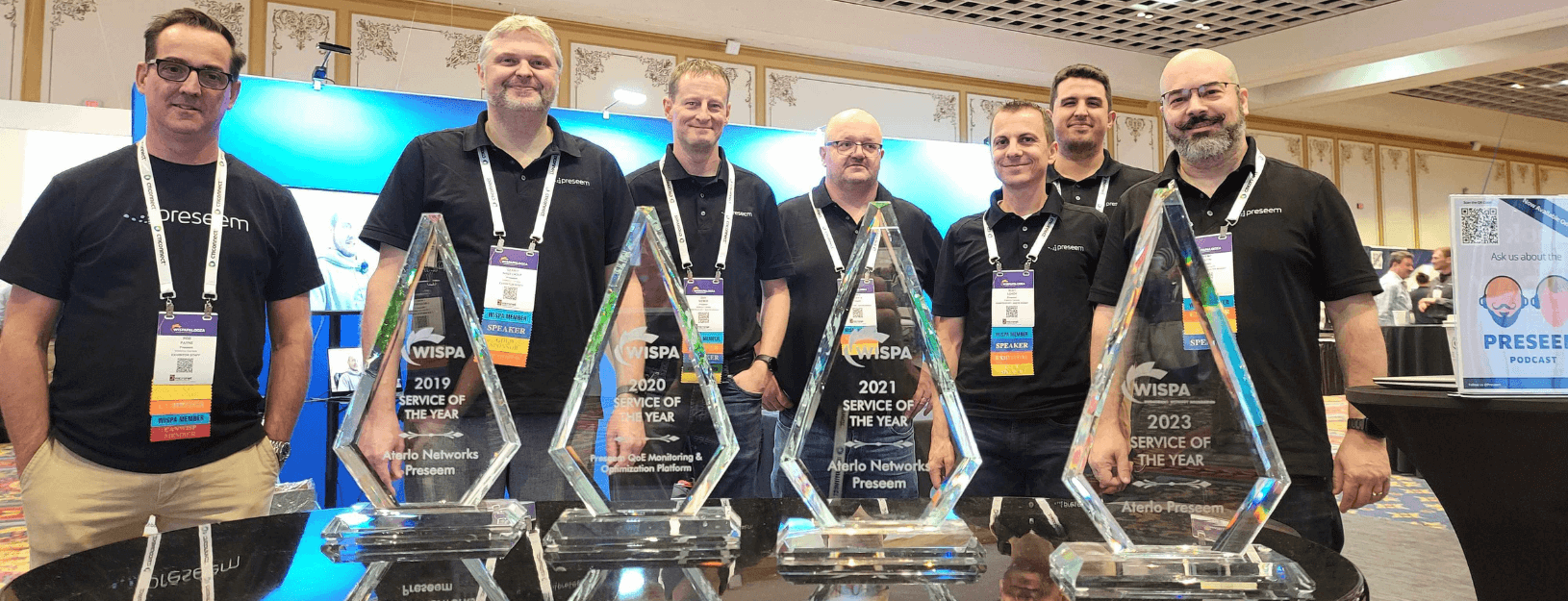
With October just around the corner, we published our annual preview of WISPAPALOOZA in Las Vegas, the industry’s largest annual get-together and trade show. We were also honored to be nominated for the 2023 WISPA Service of the Year award, voted on by WISPA’s 1,000+ members and awarded at WISPAPALOOZA. Would we win our fourth title in five years? Only the next paragraph knows for sure.
October
Yeah, we did 🙂 Once again, a huge thank you to everyone who voted for us. It’s truly an honor to be recognized by the industry for providing software that allows operators to get more out of their networks and provide a better experience for their subscribers.
Also this month, we published a blog on the importance of managing network congestion, not applications. We also released a new case study and video testimonial all about Vistabeam, a longtime Preseem customer and fast-growing ISP serving Nebraska, Wyoming, and Colorado. Check out the story and video to learn how they’ve benefited from Preseem (as an example, they saw a 50% reduction in calls overnight from customers having speed or buffering issues when they switched Preseem on).
Getting back to WISPAPALOOZA, there were some interesting discussions on changing the definition of reliable broadband under BEAD, as well as regulatory hurdles on fiber and fixed wireless broadband builds. Away from the trade show, the FCC announced their acceptance list for the E-ACAM program, while a report from analyst Omdia said that ISPs should focus on home Wi-Fi latency and QoE to ensure success. Hear hear!
November
As we mentioned all the way back in our January update, we love to celebrate the success of our customers so we were happy to see Texas ISP TekWav in the news in November. As this article explains, the company has teamed up with a local library to connect hundreds of homes and residents in the small town of Pottsboro, something they hope can become a national example. Keep up the great work!
Elsewhere, the NTCA announced new resources to help regional operators apply for BEAD funding, while the NTIA proposed alternatives to the BEAD letter of credit requirement. As well, separate reports found that the national average internet speed was up more than 40%, and that more than half of the US now has access to high-speed internet.
Here at Preseem, we published a blog on managing fixed wireless and fiber hybrid networks efficiently, and an informative article and video on capacity planning for speed tests, presented by our Chief Product Officer Dan Siemon.
December
As the year draws to a close, BEAD remains a hot topic in the industry. Earlier this month, the House Energy and Commerce Committee questioned NTIA administrator Alan Davidson on BEAD implementation issues and federal spectrum strategy. The FCC also stayed in the headlines by extending a waiver on a key broadband data collection requirement, and preparing to vote on pole attachment reforms.
Thanks for taking this trip down (recent) memory lane with us. We hope you enjoyed reading the Fixed Wireless and Fiber Year in Review 2023. We also hope you have a great holiday season, and we look forward to continuing to serve regional operators in 2024. Keep an eye out for the latest edition of the Fixed Wireless Network Report as well as some brand new fiber features for Preseem early in the new year. Until then, happy holidays from all of us here at Preseem!