Fixed Wireless and Fiber Year in Review
With 2025 about to expire, it’s time for us here at Preseem to take our annual look back at what happened in the world of fixed wireless and fiber in the last 12 eventful months. Spoiler alert: we’re going to mention BEAD a lot 🙂

January
As in 2024, the $42.5B Broadband Equity Access and Deployment (BEAD) program continued to dominate the broadband headlines in 2025. The new administration in Washington signaled a change from the program’s previous fiber-first policy to also consider “alternative” technologies, such as fixed wireless deployed in unlicensed spectrum, and low-earth-orbit (LEO) satellite broadband.
With this in mind, Telecompetitor did a deep dive on alternative technology guidelines, while the Information Technology and Innovation Foundation (ITIF) argued that BEAD needed all technologies to succeed.
There were some good news stories early in the year, with USTelecom noting that U.S. broadband prices had dropped 9.4% year-over-year, which, coupled with rising speeds, was driving up broadband’s value for consumers. Meanwhile, Fierce Network reported that, although FWA was still considered a “rural niche” in the U.S., it was seeing sizeable gains across Asia, the Middle East, and elsewhere.
Here at Preseem, we led into the Big Football Game (you know the one), with some timeless tips on reducing network congestion and support calls to ensure your regional ISP scores a touchdown (or slam dunk or KO) with your customers, no matter what big game is on.
Learn How to Proactively Tackle Network Issues
February
In February, we published a plethora of content, beginning with a couple of pieces that analyzed real-world data from ISPs deploying Tarana’s G1 technology. These included our look at the achievable link rates on Tarana radios, as well as our analysis of Tarana link rate success and a product tour showing how to use link rate metrics in Preseem.
We also published an anonymized success story of how one of our customers addressed rising churn rates by using Preseem to identify customers on legacy plans who were eligible for upgrades. The result? A 50% conversion rate, reduced churn rates, and a drop in support volume to “two or three calls a day.” You can view the associated product tour here.
In addition, we conducted an experiment on network flows in a typical home, and published the latest Preseem features in our Q1 product update.
In broadband funding news, a study by the Brattle Group found that reinstating the Affordable Connectivity Program (ACP) would have significant benefits for healthcare, education, and the labor market. Elsewhere, the Schools, Health and Libraries Broadband Coalition defended the Universal Service Fund (USF), while a study by the Benton Institute for Broadband and Society saw a rocky road ahead for the Rural Digital Opportunity Fund (RDOF).
The Benton Institute was also one of the 25 signatories on an open letter to the FCC opposing changes to the Citizens Broadband Radio Service (CBRS), along with WISPA, Cambium Networks, Comcast, Tarana Wireless, and many other heavyweights.
March
Artificial Intelligence seemed to loom over everything in 2025, and broadband was no exception. The Fast Mode examined rural broadband expansion and the AI opportunity, exploring how it might help close the digital divide.
Elsewhere, OpenSignal reported that speed lagged behind other factors for customers choosing wireless service providers. In BEAD news, some industry leaders reported that rural broadband was in trouble no matter what happened with the program, while the NCSL Foundation for State Legislatures said that states were banking on BEAD funds to fill broadband gaps.
Tired of losing customers to Starlink? This was a concern we heard more and more in 2025, as the LEO provider began to capture market share and BEAD funds. In response, we wrote a blog about it, with five tips on how to stop the bleeding and grow your business.

April
In April, we published an ebook called “How to Get the Most From Your Tarana Deployment,” which provides insights on how ISPs using Tarana equipment can maximize their network performance and operational efficiency.
We also authored an article for Telecompetitor this month extolling the benefits of a proactive approach to improve network health and subscriber QoE, and co-hosted a webinar with them outlining the key trends and insights from our ISP Network Report.
April also saw the first installment of our Best Practices for Support Teams webinar series, where our CTO Scot Loach took a look at how to solve slow internet issues with Preseem. Watch the full session below! To cap off a busy month, we published a blog on how regional ISPs should look at more than just speed when trying to reduce churn and grow their business.
In industry news, the Wireless Internet Service Providers Association (WISPA) called on the FCC to remove “burdensome and outdated” regulations, while David Zumwalt, WISPA’s CEO, asked for BEAD eligibility maps to be revised before deployment.
A number of studies on the broadband industry emerged this month, including a report from Ookla that the digital divide in the U.S. continued to grow despite improved broadband speeds overall. A study from Amdocs, meanwhile, found that providers offering a hybrid mix of fiber and fixed wireless were better positioned to satisfy consumer demands for reliability, affordability, and uninterrupted access. As well, the rural broadband subscriber study conducted by Innovative Systems found that internet speed and service price were the top drivers of satisfaction for customers.
May
More broadband industry studies emerged in May, including a survey from the American Customer Satisfaction Index showing how customer satisfaction numbers for fiber and non-fiber providers are now tied for the first time. A report from Horowitz Research, meanwhile, found that a whopping 56% of non-fixed wireless customers were likely to consider FWA when it became available in their area.
In BEAD developments, a letter signed by the leaders of five major industry associations urged the U.S. administration to move forward with the program’s deployment. Elsewhere, a panel at the Connect (X) conference in Chicago noted that fixed wireless was gaining momentum among consumers but also had plenty of room to grow in the business world.
Here at Preseem, we previewed our attendance at the 2025 Fiber Connect conference in Nashville, and hosted the second webinar in our Best Practices series for support teams. This time around, our Senior Product Manager Jeremy Austin hosted a session called Stop Guessing, Start Knowing: Using Preseem for Technical Support and Upsells—watch the full recording here.
June
In June, our Best Practices webinar series wrapped up with a session called Mastering Latency for More Efficient Support, hosted by our CEO and co-founder Dan Siemon. In this session, Dan emphasizes that latency, particularly in network delivery, significantly impacts customer satisfaction and outlines methods for measuring it effectively.
This month, we also dove into transcripts from our conversations with regional ISPs and came up with a list of the three most common network problems for fixed wireless providers.
In yet another study on the broadband industry, J.D. Power found that fixed wireless continues to outpace fiber and cable when it comes to customer satisfaction, even as FWA adoption grew 47%. On a related note, Telecompetitor interviewed the president of Zyxel Communications at Fiber Connect, who sees the rise of fixed wireless as proof that the future is hybrid.
WISPA was all over the headlines in June, backing a group of 23 Texas ISPs seeking to save the Citizens Broadband Radio Service (CBRS) from being auctioned off by the FCC, applauding the new technology-neutral BEAD rules, and reminding providers to make sure the coverage they reported to the FCC was up to date.
July
WISPA reiterated its opposition to the potential auctioning of CBRS spectrum in July, with CEO David Zumwalt warning of “costs and burdens that will be especially severe and untenable in rural America” in a letter to the FCC. WISPA also sparred with the NTCA on whether unlicensed fixed wireless should be subject to location-by-location verification in BEAD coverage maps.
Elsewhere, the ITIF reported that the use of multiple access technologies such as fiber and fixed wireless was creating robust competition, but that outdated regulations and policies—such as the FCC’s definition of broadband as 100 Mbps download and 20 Mbps upload—were limiting consumer benefits.
Here at Preseem, we put together a recap of our Best Practices for Support Teams webinar series, which provided tips and insights on how to use our proactive platform to better understand and solve technical issues efficiently.
August
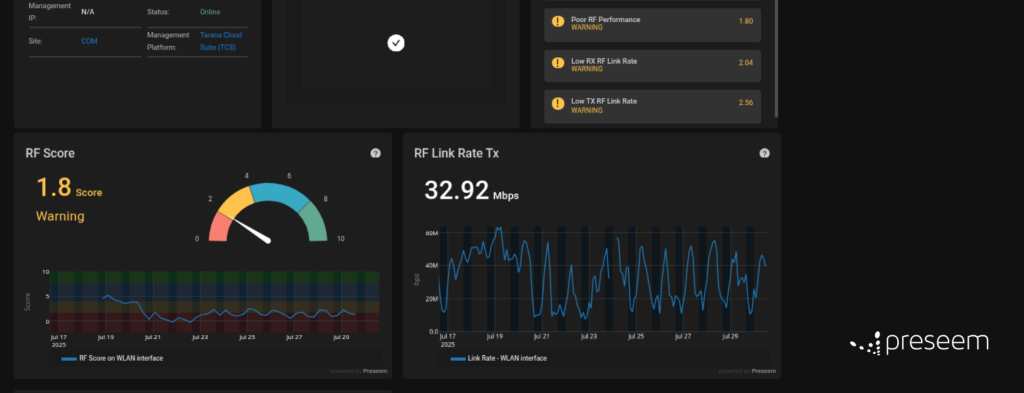
As the summer rolled on, we announced a couple of hot new feature updates 🔥 First, we introduced Offline Reasons and Times for ONTs to help fiber providers resolve ONT issues faster and work more efficiently without logging into multiple vendor platforms. Next up, we launched RF Scores for Tarana equipment, expanding the ability of ISPs to identify degrading RF conditions, prioritize field maintenance, and reduce unnecessary truck rolls, regardless of vendor.
Meanwhile, our latest blog looked at the top four business problems for fixed wireless and fiber ISPs, as determined by their frequency in our daily calls with regional providers around the world.
In industry studies, Broadband Now published their list of the Best and Worst States for Broadband in 2025, based on coverage, speed, and price.
Otherwise, it was another busy month for BEAD news, with the NTIA releasing its guide for navigating the program’s requirements, which led Light Reading to wonder “What’s going on with fixed wireless and BEAD?” For their part, West Virginia announced they were sticking with fiber for BEAD deployments, while Colorado revealed their fiber share was dropping sharply to 40% with the rest going to satellite.
September
In September, Tarana unveiled its highly anticipated G2 next-generation fixed wireless access (ngFWA) platform, and Broadband Communities released their annual Top 100 list of the players making the biggest impact in the connectivity landscape.
On the BEAD front, Telecompetitor took a deep dive on the Benefit of the Bargain round allocations, while WISPA were mostly happy with how the results turned out despite the increased prominence of satellite providers.
Elsewhere, other industry groups such as the NTCA-The Rural Broadband Association, NRECA, and the Rural Wireless Association, urged the FCC to raise the 100/20 Mbps benchmark for fixed broadband.
October
To celebrate the recent release of Tarana RF Scores in Preseem, we held a webinar to highlight how the scores help identify network issues, improve customer experience, and streamline support workflows. Co-hosted by Preseem CTO Scot Loach and Senior Product Manager Jeremy Austin, the webinar also included a discussion with Drew Beverage, COO of 360 Broadband, on how his team uses the RF Score feature with their Tarana gear to gain actionable insights and improve network performance. You can watch the webinar below, or read the recap here.
October also saw the release of our Q3 product update, which included the Tarana RF Scores mentioned above, as well as the release of our next-generation 15K and 40K appliances, new features like Disconnected Topology and ONT Offline Reasons & Times, and various enhancements.
More industry reports came to light this month, with findings including:
- U.S. broadband speeds are increasing, while the digital divide narrows (Ookla)
- 19 million older U.S. adults do not have access to broadband (AARP)
- The demise of the Affordable Connectivity Program (ACP) has had a negative impact on overall broadband subscriber adds (New Street Research)
- Consumers are increasingly choosing wireless over wired (J.D. Power)
In BEAD updates, fixed wireless access providers were awarded over 11% of BEAD-eligible locations, while SpaceX won the highest number of locations in Texas, to the tune of over $108M.
November
Some controversy erupted in November when Ookla published its WISP Report Card, claiming that most wireless providers “fail” the FCC’s 100/20 Mbps benchmark. WISPA was understandably miffed at this study of eight of the largest WISPs (out of a total of around 2,000 nationwide), calling it “fatally over-inclusive and just plain wrong.” WISPA also argued that the report “wrongly conflates speed with interference or congestion,” and said that “speed is but one small factor” in why customers choose an ISP. We agree.
A new report from The Broadband Forum revealed that fixed wireless providers were capable of providing multi-dwelling units (MDUs) with gigabit speeds, while The Fast Mode proclaimed that “fiber isn’t enough” and that forward-thinking providers are embracing hybrid networks to ensure success.
December
To end the year on a high note, we released the latest edition of our ISP Network Report, packed with exclusive data, insights, and trends from fixed wireless and fiber ISPs worldwide.
As always, the detailed analysis included network performance benchmarks, vendor comparisons, and strategic recommendations to help regional operators navigate an increasingly competitive broadband landscape.
Download your free copy at the link above, and check out our webinar for a deep dive on all the important metrics, insights, and highlights from this year’s report with our resident experts.

Also, this month Preseem CEO Dan Siemon appeared on the Beyond the Cable podcast and explained why streamlined operations are essential for regional ISPs, while Senior Product Manager Jeremy Austin spoke about Access Technologies and Internet Experience at the online Understanding Latency conference.
Ookla took a look at loaded latency and L4S in its latest research article, and also stressed the need for ongoing network performance monitoring by U.S. states. WISPA continued to urge the FCC not to touch CBRS, while also pushing four best practices for BEAD contracts. And, just in time for the holidays, CCG Consulting President Doug Dawson compiled the 2025 “broadband turkey awards” – check out the list to see if you agree 🙂
Well, that’s another colorful, eventful, and significant year in the book for fixed wireless and fiber ISPs. We hope you enjoyed reading our review, and that you have a peaceful holiday season. We look forward to continuing to serve regional operators around the world in 2026. Happy new year from all of us here at Preseem 🎉