

Access Network Operations
Manage your network proactively and efficiently with insightful RF analytics, traffic-based QoE measurements, and a single pane view of your access network operations.
Work Smarter with AP and CPE Radio Metrics
Preseem provides a common interface to view and investigate APs and CPE Radios across vendors and models. Metrics are normalized across vendors and collected continuously on one-minute intervals. This allows your access network operations team to answer questions and investigate issues without actually needing to login to or learn vendor tools. As well as making life easier for the team, this helps improve efficiency by:
- Reducing training time and vendor-specific expertise requirements for network staff
- Lowering any risk associated with multiple people accessing vendor configuration tools
- Making it easier to add new vendors and models, and increasing deployment flexibility
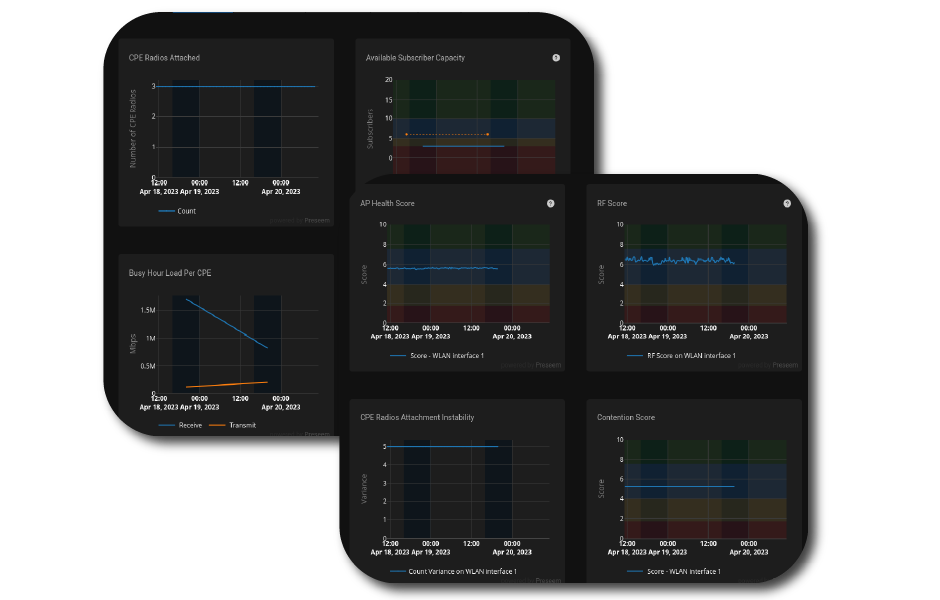

Tackle Network Issues Proactively with AP and CPE Radio Scores
AP and CPE Radio Scores help your access network operations team identify and prioritize areas of the network to improve or fix before the customer notices or calls. Here’s a few ways they can help your team become more proactive and effective:
- Identify APs or CPE Radios with poor RF conditions with a single, sortable score that can be used to drive proactive network improvements
- Find APs that deliver a poor experience with a single, sortable AP Health score that can be used to prioritize work
- See the CPE Radios that are having the biggest negative impact on a fixed wireless network’s most valuable asset—airtime
- Reduce the expertise required to identify APs or CPE Radios with poor RF and make your in-house experts more efficient. Let them spend their time fixing problems instead of looking for them!
Truly Understand the Subscriber Experience
Preseem takes high granularity subscriber traffic-based QoE measurements and ties them directly back to the topology, all without adding traffic to the network. In our years of experience, we’ve found that traffic-based metrics are the only way to really understand the subscriber experience.
They’re also actionable, meaning they help your access network operations team:
- Proactively target investigations and improvements into areas of the network that are delivering a poor experience
- Quickly identify if any quality problems are in the network or are specific to one subscriber
- Get insight into network usage and growth through historical metrics
- Target investment to the areas that need capacity the most, not areas where new customers can already be supported


Save Time for Your Team
Our cloud-based architecture provides a centralized view across all vendors, models and inline elements, so there’s no need to log in to different locations or servers to see different parts of the network. Also, our subscriber topology and element search capabilities mean your team can quickly jump to information and metrics associated with any subscriber or access technology element (AP).
Our Automatic Access Network Discovery can also help save time by:
- Requiring less provisioning information, making integration easier and reducing TCO
- Improving subscriber and topology mapping accuracy for Preseem use cases
- Allowing your team to audit provisioning information in other systems using Preseem data
"We’ve been able to lower our churn rate, increase our customer satisfaction, decrease our call volume. It’s just all around made us more efficient. Customers are happy, we’re more profitable."
Andrew Wicker
COO, Vistabeam
Related Media and Articles
From Plans to Performance: Analyzing Tarana Link Rate Success
Introduction Tarana’s G1 technology brings ISPs a powerful tool for delivering high-speed broadband connectivity to subscribers who did not have this option before. At Preseem, we collect a lot of data from ISP access networks to help operators move from reactive to...

A Small Study of DSCP Usage at US Regional Providers
A Small Study of DSCP Usage at US Regional ISPs The IP Differentiated Services Codepoint (DSCP) field (RFC 2474) is a mechanism that enables traffic to be treated differently by the network. This mechanism has seen little adoption on the public Internet due to...

Tarana G1 in Action: Achievable Link Rates in the Real World
Tarana G1 in Action: Introduction Tarana’s G1 technology brings ISPs a powerful tool for delivering high-speed broadband connectivity to subscribers who didn’t have this option before. Like all vendors, Tarana publishes datasheets that include maximum bitrates. At...

Reduce Network Congestion and Support Calls
Reduce Network Congestion and Support Calls In November last year, Netflix ran into a bit of a PR disaster when its live stream of the Mike Tyson-Jake Paul boxing event dissolved into a buffering and glitch-filled debacle that drew more than 100,000 reports of network...

Fiber ONT Rx Power vs. Length Over Seven Days
ONT Rx Power vs. Fiber Length Over Time This post is the last in our short series exploring light levels (signal strength) in PON fiber networks. In the first post, we looked at Rx power vs. fiber length. The second post explored attenuation (Tx power minus Rx power)...
Tower Density and Frequency Reuse in Tarana Deployments
Introduction Tarana’s G1 technology brings regional ISPs a powerful tool for delivering high-speed broadband connectivity to subscribers that did not have this option before. However, deployment choices—such as the number of sectors per tower and frequency reuse...

Analyzing Network Data
How to Use Network Metrics to Deliver Business Value At WISPAPALOOZA 2024 in Las Vegas this October, Preseem co-founder and CTO Scot Loach delivered a presentation called Analyzing Network Data. This video is a re-recording of that session and focuses on four...
Fiber Attenuation vs. Fiber Length
Fiber Attenuation and Length for Adtran and Calix A few weeks ago, I posted an analysis of signal strength vs distance in fiber (PON) networks based on a random sampling of ONT stats in Preseem. This is what that looks like for Adtran and Calix respectively. After...

Tarana Connected Clients vs. RF Utilization
Connected Clients vs. RF Utilization on Tarana At Preseem, we collect a lot of data from ISP access networks to help operators move from reactive to proactive operations and make their teams more efficient. Tarana is a recent entrant to the world of Fixed Wireless,...

Urban and Rural FWA Deployments
Exploring FWA Deployments by Population Density As a (now mostly former) wireless ISP operator, I’ve noted that rural, sparsely populated service areas often need subsidies to combat a difficult ROI. Government subsidies are both complicated and controversial. Using...
The Preseem Podcast
Check out our podcast for episodes on core network operations and more!
Preseem YouTube Channel
Check out our YouTube channel for videos on access network operations and more!

Get Started Today
Take an interactive product tour, watch the Preseem overview, or get in touch to put Preseem’s Proactive approach to work for your network today.

1-833-773-7336
295 Hagey Boulevard
1st Floor, West Entrance Waterloo, ON N2L 6R5




© Aterlo Networks 2026 | aterlo.com
