

Shifting subscriber behaviors and increased usage of real-time entertainment applications are putting more and more pressure on today’s networks to keep up with the still-growing demand for wireless data.
According to a recent CTIA report, Americans consumed over 100 trillion MBs in 2023—that’s more wireless data than 2010 to 2018 combined. It’s also the largest single-year increase ever, up 36% from the previous year.
This trend shows no sign of slowing down, with Ericsson predicting that Americans’ data use will increase more than threefold by 2029.
Given the heavy competition in the fiber and fixed wireless markets, these indicators may understandably spur rural ISPs to offer increasingly larger speed plans in an attempt to reel in and retain subscribers whose appetite for consuming bandwidth seems insatiable.
There’s only one problem with this approach, however: the majority of subscribers don’t actually care about speed.
It’s Not All About Speed 🏃
As Sylwia Kechiche of Opensignal explained in a podcast with Light Reading in March 2025, “speed is not how users measure the experience.” In fact, only 19% of respondents to Opensignal’s recent US Household Survey said that speed is their top consideration when considering a wireless carrier.
As might be expected, cost is the number one factor on consumers’ minds (67%), but it’s followed closely by reliability (58%), coverage and network quality (both 54%), and customer service (25%). These all rank higher than speed or even a recommendation from a friend or family member (11%).
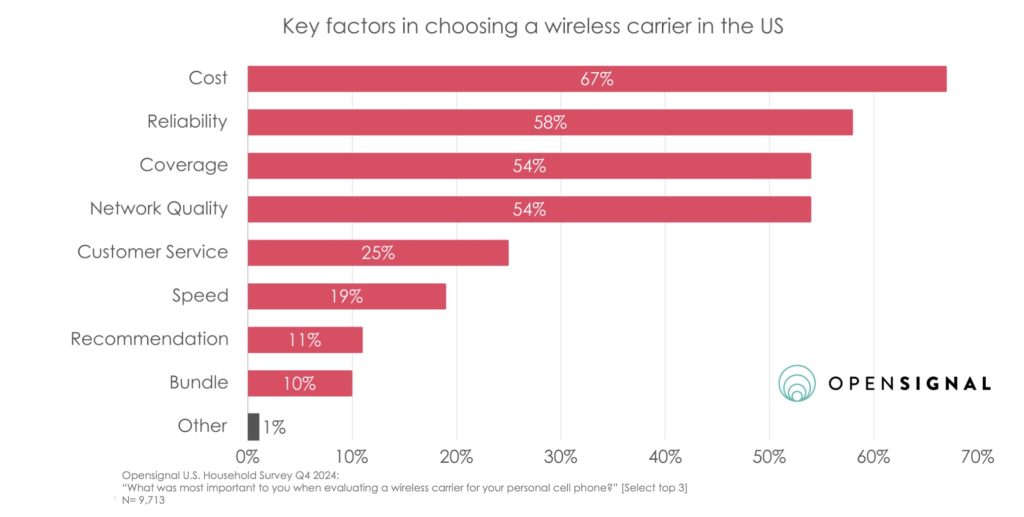
As the Opensignal report points out, speed is not a top concern for subscribers because “there are no mainstream applications that require ultra-fast speeds.” Nobody needs a 10GB plan to stream The White Lotus or scroll through their TikTok feed, for example.
Another recent survey—the 2025 Rural Broadband Subscriber Study by Innovative Systems—found that the number one driver of high internet satisfaction was Good/consistent connection speed (68%).
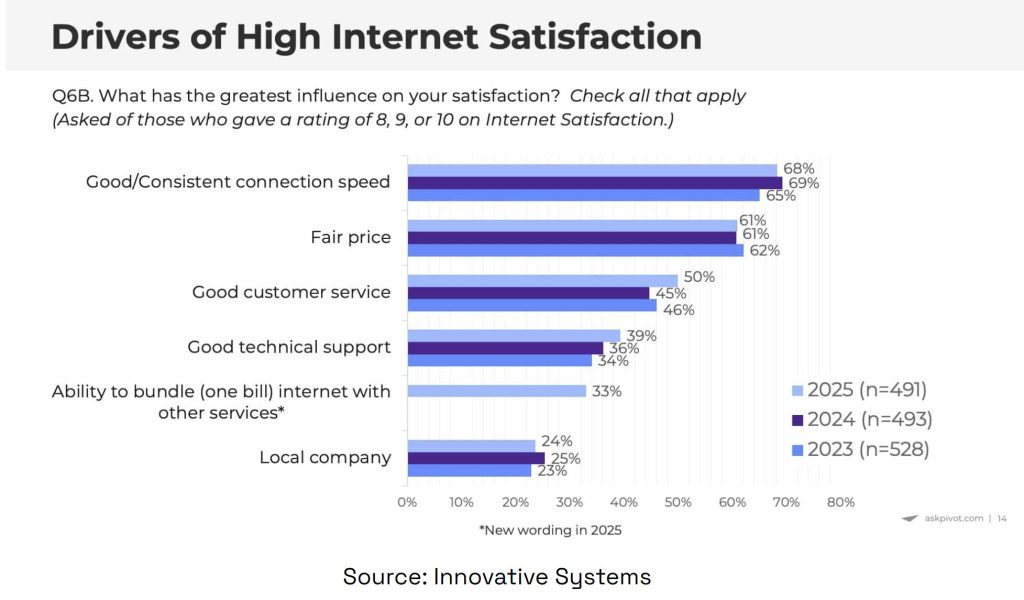
At first glance, this may seem to contradict the statements above. However, we should note that subscribers here are not saying that plan speed size is most important to them, just that they want a reliable connection that doesn’t drop in and out all the time.
That means being able to game and stream online without lag, enjoy buffer-free video calls with family or colleagues, and enjoy a stable, low-latency connection that always feels fast, no matter what their actual plan speed might be.
Change the Conversation with Your Subscribers 💬
That said, of course, there are some customers who are concerned with speed and who may be under the impression that they need the highest package to get the best performance.
However, as Aaron Brace, VP of Engineering at cable provider Breezeline, put it at the recent New England Connectivity and Telecommunications Association (NECTA) conference, “For most customers, 100 Mbps to maybe 200 is fine. I think people have a more grandiose view of how much speed that they actually require.”
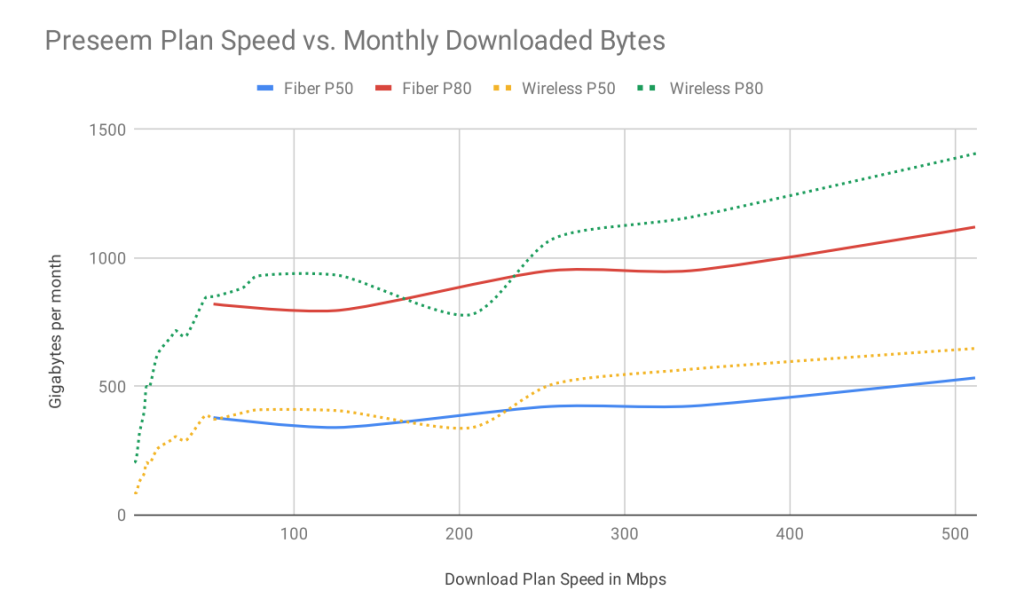
Our own studies back this up. In Preseem’s annual ISP Network Report, we analyze billions of data points from our worldwide customer base to provide unique industry insights and trends.
As one example, we explored the relationship between plan speed and actual data consumed. We found that the median user doesn’t actually use much more data as their plan speed increases, especially once you get above about 50 Mbps. As noted in the report, “This likely suggests that gigabit plans are not required for the vast majority of subscribers.”
Download the 2025 ISP Network Report
This doesn’t mean that rural ISPs should stop offering 1GB plans to residential subscribers. However, it’s important to educate your customers and prospects that plan speed is not necessarily an indicator of quality, and that lower (and less expensive) plans can provide them with the quality of experience that suits their online habits.
For example, offering more personalized packages based on subscriber interests can ensure they get the plan speed they need, not the one they think they want.
Speaking at a recent Fiber Broadband Association (FBA) webinar, Alzbeta Fellenbaum of technology analysts Omdia provided some suggestions. “Rather than just focusing on pure speed offering, targeting users based on their user preference, based on what they do, based on their personas, can help,” she said.
“So, we can talk about lower latency for gamers and dedicated Wi-Fi traffic streams for home workers. Families will appreciate parental controls and more cybersecurity for their kids. If someone is an online entertainment buff and wants the highest quality video, that can also be tailored and prioritized.”

Maintain a Healthy and Reliable Network 🧑⚕️
So, if bigger and faster plan speeds are not the answer for rural ISPs looking to attract and retain customers, what are some other options that can help differentiate them from the competition?
As seen in the Opensignal survey at the beginning of the article, reliability and network quality are high on the list of subscriber concerns when choosing (or thinking of leaving) an internet provider.
In our experience, maintaining a healthy and reliable network not only brings internal benefits like increased efficiency and a higher return on investment, but also a drastic decrease in “slow internet” calls, less customer frustration, and more positive reviews and recommendations for your business.
For more proof of this, let’s look again at our ISP Network Report. For this year’s edition, we conducted an Operational Survey of regional ISPs who use Preseem to help develop industry benchmarks on network-related support tickets, support call resolution times, and churn.
Here are some highlights of what we found:
- ISPs with over 50% of support tickets related to network issues are more likely to have churn rates above 10%
- ISPs with less than 25% of support tickets related to network performance tend to report churn rates below 3%
- Providers with a Net Promoter Score (NPS) of 61 or more report that less than 25% of their support tickets are related to network performance issues
These results indicate that:
- Network reliability is a key driver of customer retention
- Reducing support resolution times correlates with reduced churn risk
- Proactive network management greatly impacts customer satisfaction and retention
Download your free copy of the ISP Network Report to find out more about these topics, and get additional exclusive insights and metrics.
Provide and Promote Exceptional Customer Service 📢
In response to an FCC review of customer service in October 2024, lobby groups for cable and major telcos argued that providing a positive customer experience was a necessity in a highly competitive industry.
As US Telecom put it, if “a provider fails to efficiently resolve an issue, they risk losing not only that customer—and not just for the one service, but potentially for all of the bundled services offered to that customer—but also any prospective customers that come across a negative review online.”
Cut to every rural and regional ISP furiously nodding their heads in agreement. In fact, the stakes are even higher for small rural ISPs, for whom high churn rates and a mass of negative reviews could remove their ability to compete entirely.

Again, the ISP Network Report supports this. For example, we found that higher churn rates affect ISPs with <1,000-5,000 subscribers more prominently than ISPs who have more than 5,000 subscribers. This likely speaks to the highly competitive markets that smaller ISPs operate in and the greater access to resources that larger companies may have in place to better retain subscribers.
As mentioned in our blog on how to stop losing customers to Starlink, however, rural ISPs have an advantage over larger competitors by being able to offer local knowledge and personalized, live support that means subscribers don’t have to navigate automated phone systems or sit on the line for hours to get help.
Providing (and promoting) your excellent customer service can help reduce churn, as well as attract and retain subscribers who’ll recommend your service to others.
How Preseem Can Help 🤝
As Alzbeta Fellenbaum said during the FBA webinar mentioned earlier in this article: “In the North American market specifically, Omdia found that consumers are concerned with speed but place a higher value on a reliable and consistent connection along with efficient and high-quality customer support.”
Preseem can help your ISP address these concerns in a variety of ways.
For network ops teams, our platform helps manage your network proactively and efficiently with insightful analytics, pre-built integrations, and a single pane view of your operations. With Preseem’s unique metrics, you can identify and prioritize areas of the network to improve or fix before the customer calls tech support.
For customer support staff, Preseem provides the tools they need to find the root cause of issues faster, access relevant information quickly, and increase their expertise and efficiency. This leads to faster support call resolution times, fewer escalations, and happier customers.
While these are great examples from customers about how Preseem is helping them move beyond speed, we know that seeing is believing. Take an interactive tour of how our proactive platform helps you drive more efficient network operations, customer support, and grow revenue through targeted upsells.