

Reduce Churn, Improve Customer Satisfaction, and Grow Your Business
In August 2024, SpaceX told the FCC that Starlink has over 1.4 million subscribers in the U.S. And, as Fierce Network reports, “the majority of Starlink customers (85%) reside in rural areas. Most customers either switched from a small rural provider or never had an internet service provider (ISP) before … with 11% of subscribers reporting they are new to home internet.”
In other words, Starlink has a large and growing customer base that’s been built largely on convincing subscribers at regional ISPs to change providers. So how can rural operators slow this leakage?

In their Survival Guide for Local ISPs in the Starlink Era, Splynx point out that “Y Combinator research found that reducing subscriber churn is 2.3 times more effective in driving growth than acquiring new customers. Moreover, boosting the revenue generated from your existing subscriber base by increasing the average revenue per subscriber (ARPS) is a remarkable 3.8 times more productive in terms of revenue growth.”
In this blog, you can learn how to effectively compete with Starlink with a real-world example of how one Preseem customer turned their losses around. We’ll also look at various ways to reduce churn to Starlink and other competitors, including how proactively improving customer satisfaction can help grow your business, including (click on each to jump to that section):
- Survey Your Customers
- Remind Subscribers That You’re Local
- Promote Your Price Advantage
- Emphasis on Support
- Low Latency is More Important Than Speed
- How a Preseem Customer Turned Their Starlink Losses Around
Survey Your Customers/NPS
The first step in reducing churn is to get an accurate picture of how your subscribers feel about your company and services. One of the fastest and easiest ways to do this is to start measuring Net Promoter Score (NPS). Created by Bain & Company, NPS is “a single, easy-to-understand metric” that measures customer loyalty.
All you do is ask your customers how likely they would be to recommend you to others, on a scale of 1-10. Those who answer with a 9 or 10 are considered “promoters,” while a 7 or 8 means they’re “passive,” and anything 6 or below means they’re a “detractor.”
These results are then calculated to give your company a score of anywhere from -100 to 100. Scoring at either of these extremes is wildly unlikely (a score of -100, for example, would mean that every single one of your customers is a detractor). In fact, a “good” NPS score is anything 0 and above (meaning the number of promoters outnumber your detractors). Anything above 50 is considered excellent, while a score of 80+ is considered world-class.

We recently conducted an Operational Survey of ISPs using Preseem, and found that operators who measure customer satisfaction and/or have a good NPS score report lower churn rates and better network performance. The full results are included in our annual ISP Network Report but, as one example, we found that 83% of ISPs who report an NPS of 61 or more report churn rates of less than 3%. To put it another way—the higher the NPS, the lower the churn.
Measuring customer satisfaction using NPS or other metrics is highly recommended as a way to halt and reduce churn. You can also use it to implement practical ideas like:
- Create an incentive program and run a campaign encouraging your Promoters to bring in more referrals (e.g. one free month of service for each new customer they refer), or leave a positive review for your company on Google or your preferred review site
- Contact your Detractors to find out how you can do better. Maybe price is the issue, maybe they’ve been silently enduring laggy internet and are thinking of churning—it could be anything. However, if you know what the problem is, then you can take steps to solve it and turn those detractors into promoters!
Download the 2025 ISP Network Report
Remind Subscribers That You’re Local
One major advantage that any rural ISP has over Starlink (and the major telcos, for that matter) is its status as a local business. Study after study shows that people prefer to buy from a local company over a chain or national business. Our friends at Oregon ISP Hunter Communications published a blog outlining why it’s better to choose a local internet provider, with reasons including community support and investment, and supporting local jobs.
If you’re not doing so already, consider making your status as a local business a strong part of your marketing strategy. Put it on your trucks, yard signs, flyers, door hangers, and, of course, your website. We wrote a blog on this topic way back in 2019 and, though slightly dated now, some of the suggestions included then are still applicable, including:
- Community engagement—sponsor a local event or your kids’ sports league, organize a staff event to volunteer at the local food bank and post it on your company social media accounts—whatever you choose, deep involvement in the community will resonate with your customers and prospects
- Run geo-targeted ads on Facebook and Google to generate leads in your service area
- Sponsor recurring radio spots, like an hourly traffic update (you can even have fun with puns in the ad copy, referencing how you relieve network traffic/congestion 🙂)

Also, make sure that your Google Business Profile is up to date and that your business is represented in any relevant local online directories. The bottom line is reminding your customers and neighbors that when they choose local, their money stays in the community instead of ending up in the pockets of billionaires.
Promote Your Price Advantage
In addition to advertising your status as a local business, you can position your services as a more cost-effective alternative to Starlink.
This article on CNET warns consumers about the satellite provider’s “steep price tag,” noting that subscribers can “expect to pay $120 a month for the standard home internet service, plus $349, give or take a hundred bucks, for the equipment needed to get started. Starlink is also imposing a one-time $100 congestion charge in some areas. The monthly rate on mobile service may be lower, but so are the expected speeds.”
If your prices are competitive with these, consider having a side-by-side comparison chart displayed prominently on your website or in social media posts.
Emphasis on Support
Beyond just comparing costs, it’s also important to compare the value that you provide your customers. Stress the “bang for your buck” that consumers can expect when choosing your service over Starlink or a big telco. A huge part of that will be the personalized and responsive support you provide to your customers.

As an example, Preseem customers New Era Broadband, a WISP located in Pomeroy, OH, put “Personalized Customer Service” at the top of their Why Choose a Local ISP? article, noting that rural ISPs can provide a personal touch and local knowledge that large providers with outsourced support simply can’t match.
Shameless plug alert: Preseem can help your ISP provide even better support by providing the following benefits:
- Reduce time-to-root cause: Preseem’s QoE measurements are tied directly to the network topology, allowing support team members to swiftly identify if a problem is in-network (e.g. a poorly-performing AP) or specific to the subscriber (e.g. an issue with in-home Wi-Fi), and resolve issues faster.
- Reduce vendor training costs: Unifying AP, Tower, CPE Radio, ONT, PON, and OLT Metrics in a single UI saves on both support time and costs by reducing training and vendor-specific expertise requirements for support and network staff. They also provide a common interface that allows the team to answer questions and investigate customer problems without needing access to or learning specific vendor tools.
- Reduce support call volumes and truck rolls: Preseem provides visibility on each individual subscriber via our high granularity traffic-based QoE measurements. This helps improve customer engagement when they call the support line, as your rep can understand what the customer is seeing and look at historical information to confirm. This also means fewer costly truck rolls, as some issues can be detected and solved without requiring a technician visit.

This is relevant because, in the Operational Survey included in the ISP Network Report mentioned earlier, we found that ISPs with more than 50% of support tickets related to network issues are more likely to have churn rates above 10%, while respondents with less than 25% network-related tickets tend to report churn rates below 3%. In other words, proactively tackling network issues reduces churn (as well as support calls and resolution times).
If you’re a Preseem customer, you can also let your customers know that your service is Powered by Preseem, meaning they can expect a smooth internet experience even during peak busy times, as well as low latency and faster support call resolution, thanks to your company’s wise use of our award-winning, proactive platform 🏆💪
Educate and Upgrade
Another reason your subscribers might churn to Starlink or other competitors is the promise of faster download and upload speeds, or what they perceive to be a better internet plan. To combat this, it’s a good idea to a) educate your customers on the advantages of low latency over advertised speeds and b) upgrade them from legacy plans (where possible).
Low Latency is More Important Than Speed
As mentioned in our blog on how to reduce latency for ISPs and subscribers, it’s our view that low latency is more important than throughput when it comes to giving subscribers a superior quality of experience.
Our friends at Swift-net, a WISP based in Saskatoon, make a great point about this in their recent WISPs vs. Starlink blog. They note that WISPs “offer lower latency, essential for gaming, video calls, and real-time applications. Starlink’s satellite systems, while impressive, still face latency challenges compared to ground-based solutions.”
The emphasis in the above quote is ours, because we say follow Swift-net’s lead and shout this from the rooftops to your customers and prospects—if their house includes gamers or remote workers, or if they enjoy watching shows on popular streaming sites, then your service is the better option.

How a Preseem Customer Turned Their Starlink Losses Around
On the other topic of the importance of upgrading customers from legacy plans, we have a recent example from a Preseem customer—a California-based WISP with 5,000 subscribers—whose use of this tactic to reduce churn is documented in this recent success story.
As a senior network engineer at the ISP explained, “We were seeing high customer churn because they were still on our legacy 10 Mbps packages, but we now offer 25, 50, 75, and even 100 Mbps plans. They weren’t giving us the opportunity to upgrade them because they simply didn’t know we offered these plans.”
Using Preseem helped them easily identify customers on legacy packages, and calling those customers to upsell resulted in a 50% conversion rate and an immediate reduction in churn. “Customers were leaving us without even giving us a chance, but now we’re proactively retaining them by showing them the value of our current service offerings and packages,” they said.
Take the Fastco/Preseem Product Tour
Also, as noted in our ISP Network Report, “the median user (typical of “most” users) does not use much more data as the speed plan increases, particularly above about 50 Mbps. This likely suggests that gigabit plans are not required for the vast majority of subscribers. Fiber plans largely are not sold below 50 Mbps, so the increase is very similar to wireless at higher speeds.”
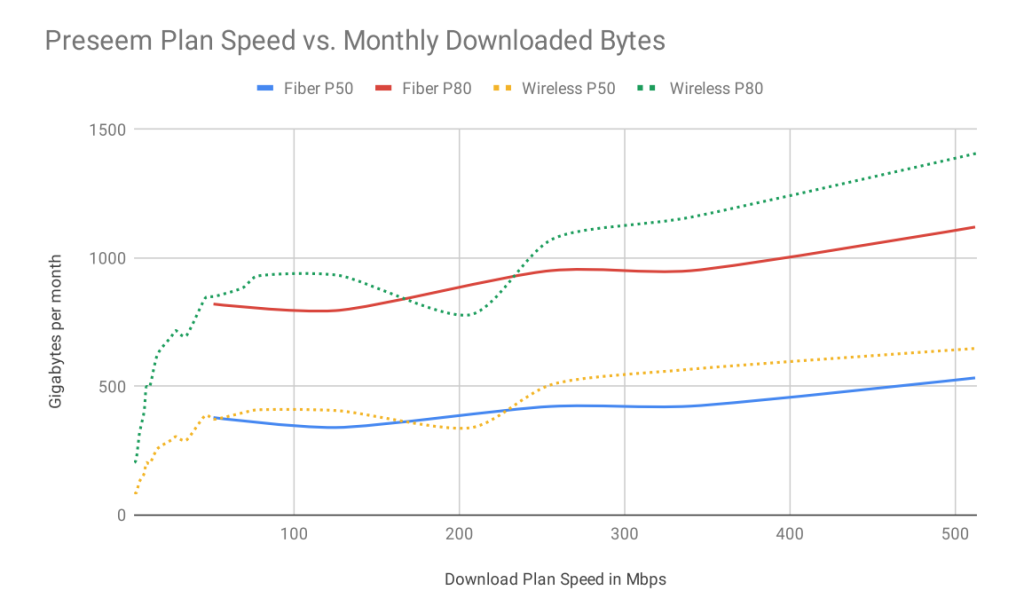
In other words, customers may be drawn in by competitors offering “better plans” that offer higher and higher speeds, but most subscribers don’t actually need those big plans. If you can identify those customers and perhaps offer to upgrade them to a plan that actually suits their needs, it can help remove that churn risk factor.
To sum up, it’s important to emphasize to your customers that WISPs are not just less expensive than Starlink, but also a better option that’s more stable in speed and latency. Starlink works best in areas where WISPs can’t reach, and/or where it’s not cost-effective to do so. On an equal playing field, however, the local WISP option is usually the better one.
If you’d like more information on how Preseem can help your rural ISP reduce subscriber churn to Starlink and other competitors, contact us to schedule a demo on a live network and get started with our 30-day free trial.