Centralized Plan Enforcement for ISPs
Subscribers maxing out their plan rate speed can be a critical issue for regional ISPs. This common problem can cause a poor quality of experience (QoE) for the customer and a headache for your support team. Left untreated or unidentified, it can also lead to subscriber churn and put a dent in your company’s reputation.
Traditional bandwidth shapers can enforce plan rates but also slow down other devices in the home once a plan’s limit is reached. A classic example would be a large game update taking up all the available bandwidth and making it impossible for others in the house to stream shows or browse the internet.

At Preseem, we’ve seen many plan enforcement issues from working directly with hundreds of ISPs around the world. As a result, we’ve shaped our system to address these common bandwidth control problems and help operators become more efficient and delight their customers. A few of the advantages we provide include:
- Find out who’s constantly maxing out their plan: This means you can upsell the client to a larger plan or suggest an equipment upgrade. The subscriber will get a better experience, and your support call volume will drop—everybody wins!
- Integrate with your billing system: Reduce double data entry, manual work, and the capacity for human error. You’ll also improve your in-house expertise and support resolution times because staff no longer need to learn multiple vendor tools.
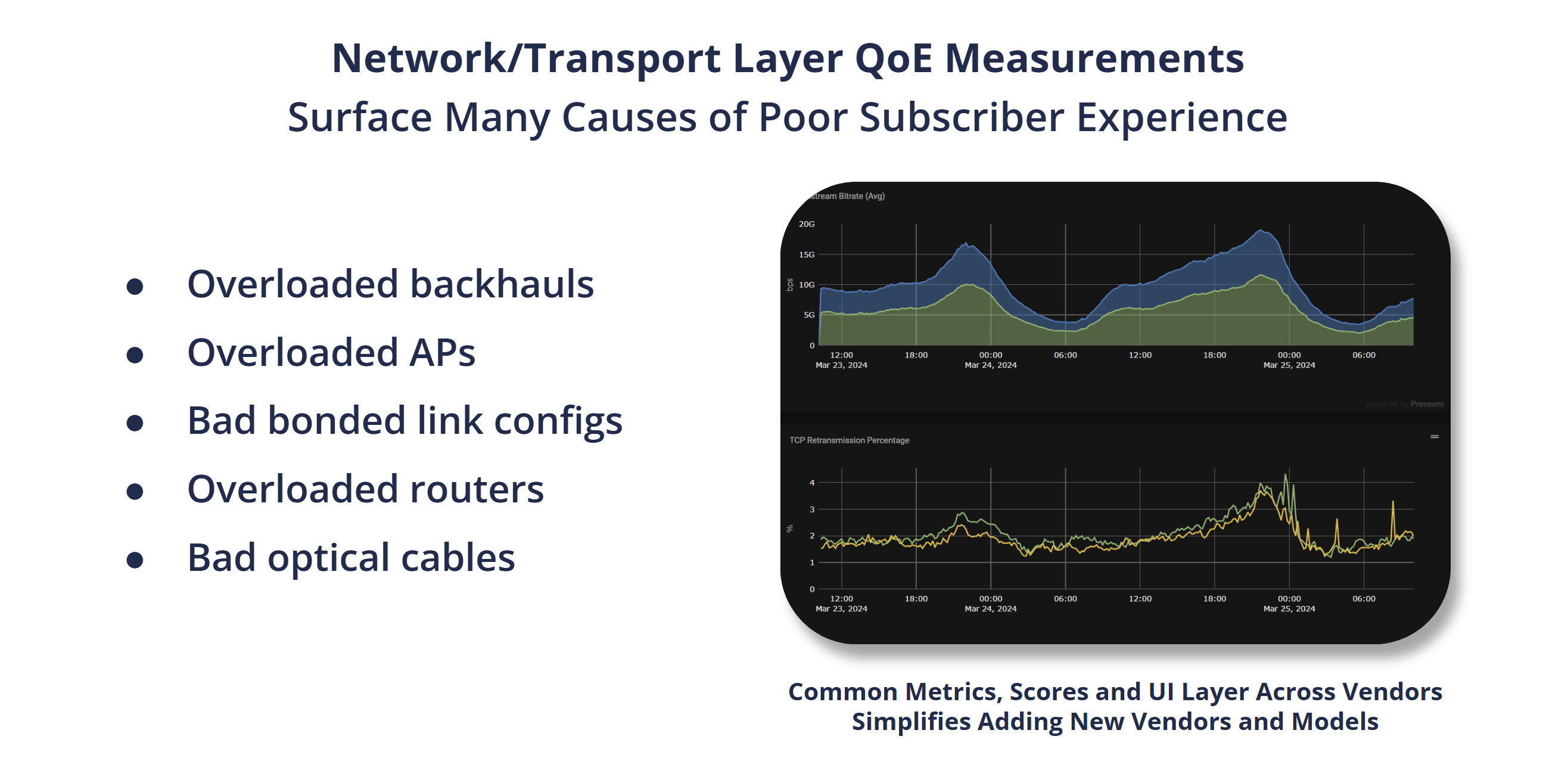
- Identify exactly where issues are occurring: Are QoE issues in the network, the customer’s equipment, or even inside the home WiFi? Preseem tells you.
- Get everything in one place: By having a single platform to view everything (subscribers, billing, APs/PONs, etc.), you get the context you need to spot opportunities to upgrade capacity, upsell clients, and drive new revenue.
Solve Self-Congestion Issues with AQM
Before we examine each of these benefits in detail, it’s valuable to consider why plan enforcement is necessary in the first place. As mentioned above, one of the most common causes of poor QoE is when a subscriber hits their full plan bandwidth and self-congests their own link.
An example of this would include a large OS update saturating the connection, negatively impacting the latency-sensitive experience of gaming and VoIP applications. This inevitably leads to a “slow-internet” support call or ticket from a customer frustrated by their negative experience.

The reason the customer experience degrades rapidly as the link approaches congestion is that most devices employ simple “first-in, first-out” (FIFO) buffering schemes, which add latency and eventually loss across all flows.
Traditionally, some ISPs have tried to address this challenge with complex Deep Packet Inspection (DPI) systems, using signatures and heuristics to attempt to identify the application associated with individual network flows, and packets to classify them for queue placement. Since internet applications are constantly changing, these approaches are highly resource- and labor-intensive, since they require frequent signature updates and maintenance of complex configurations.
Preseem’s QoE-optimized plan enforcement is based on modern active queue management (AQM) techniques that keep latency and loss low, even when the link is near full capacity. This provides isolation between flows so that one flow can’t negatively impact another and by more intelligently managing the packets that do need to be queued.
Bottom line: The subscriber experience remains good, even when they’re maxing out their service plan. That means fewer support calls for your team to deal with, and happier customers more likely to deliver referrals and positive online reviews.
Learn more about how to lower latency to improve subscriber QoE in our blog.
Understanding and Enforcing Subscriber Plans
Preseem contains views called Accounts, Services, and Packages that allow you to easily see which services a customer is paying for and how those services are attached to the network.
We pull customer data from a large number of supported billing systems or can have the data pushed via a public API. You can then list, sort, and filter the customer data, and navigate between customer and network views. This means you’re able to:
- Understand what customers and plan speeds are being serviced by access equipment in your network, such as Access Points and CPE Radios
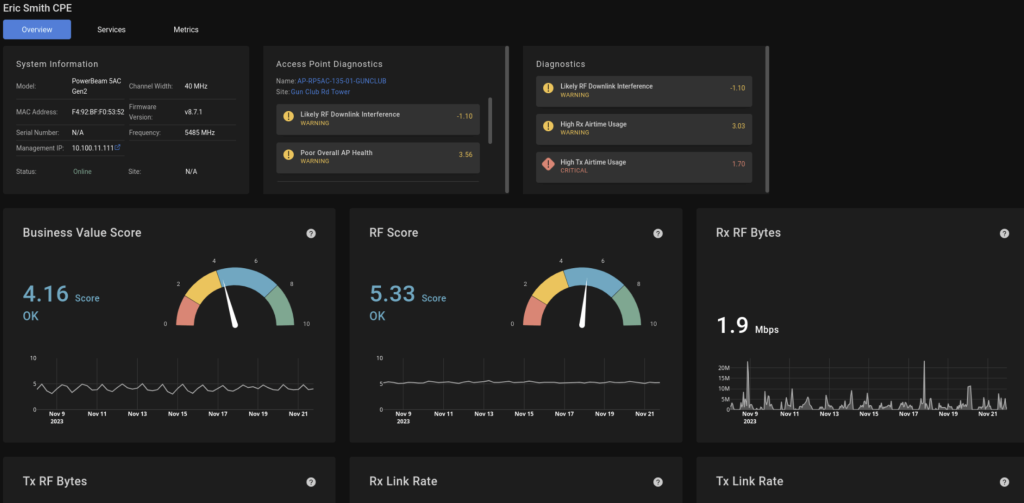
- See what plan speeds are being enforced by Preseem, and whether customers are able to achieve their plan speeds with a good quality of experience
- Easily link from Preseem to your billing system to update service information in real-time
- Analyze package subscriptions to understand which packages are most commonly used
You can also view data usage (throughput and tonnage) for each Account and Service as collected both from the network elements and the Preseem inline element and easily compare throughput to the Service’s set rate.
Our pre-built integrations with major billing systems make updating service plans a breeze, while issues can often be investigated with a single click by drilling into the Network Element to investigate its diagnostics and access scores.
Benefits for ISPs
Avoid Silent Churn
Not everyone who’s having a poor experience is going to complain loudly and give your support team a chance to solve their issues and keep them in your customer base. Many will simply suffer in silence for a while, assume that your company delivers “spotty internet,” and then quietly leave for a competitor.
This kind of “silent churn” can be very damaging, as a) you don’t get a chance to try and retain the customer and b) studies show it can cost 5x more to attract new business than keeping existing customers. Not to mention you may be at risk of poor word of mouth or negative online reviews. Moreover, increasing customer retention by just 5% can increase profits by 25-95%.
Silent churn is a possibility for customers who are regularly maxing out their plans or who are on a plan that’s too low for their household needs. This is where Preseem can give you a competitive advantage.
For example, as mentioned above, our QoE-optimized plan enforcement powered by AQM can remove silent churn risks before they emerge by ensuring a positive experience for subscribers, even when they’re maxing their plans. Also, your network operations team will be able to use Preseem to reduce silent churn and support calls by finding problem areas in the network before subscribers submit a ticket.
Identify Issues and Upsell
In addition to the above, you can use the system to identify where there’s capacity in the network and who your upgrade candidates are, so that you can precisely target those customers and move them onto higher plans or upgrade their equipment to reduce churn risk.
You can also use Preseem to identify QoE issues inside of the home WiFi network that could be causing issues. This could trigger an upsell campaign to move those customers to a managed WiFi service or a home router upgrade to improve their experience.
Reduce Integration Complexity and Save
Preseem comes with integrations to many major billing systems, reducing the workload for your network operations team, saving on operational costs, and ensuring easy and effective plan management. You’ll also reduce manual work and the capacity for human error, and Preseem can even block access automatically for accounts who have not paid their bills.
As an example, our customer Minnesota WiFi uses our integration with Azotel to stay in sync with changes to subscriber packages, account status, and equipment. Some of the benefits they’ve seen include:
- Ability to change a plan speed in Azotel and see it take effect automatically in Preseem
- When a customer is suspended for non-payment, Preseem automatically blocks their access, eliminating all of the manual work and human error that can happen when updating plan rates and disconnecting services for non-paying customers
- Automatic service resumption when a previously non-paying customer pays via the company’s online portal
As Minnesota WiFi’s owner Darin Steffl told us, “Preseem’s integration with Azotel for speed plan implementation and disconnecting non-paying customers has saved us tons of time and money.”
Want to join the A-Team for plan enforcement and efficiency? For a deeper dive into Preseem’s overall capabilities for fixed wireless, fiber, and hybrid networks, contact us to book a demo and we’ll walk you through a personalized tour showing you how the system works on a live network.