Coming Soon: Preseem Fiber Features

Header for Preseem fiber features launch preview blog

Preseem to Launch Fiber Features for Hybrid ISPs

In recent years, fixed wireless operators have been feeling the squeeze from both sides.

On one hand, fiber and cable providers have been overbuilding in areas typically served by WISPs, driven by consumer demand and billions of dollars in funding.

On the other, major telcos like T-Mobile, Verizon, and AT&T are expanding their fixed wireless presence, attempting to lure customers with promises of low prices and high plan speeds.

As a result, many regional operators have begun adding fiber as a means to use the optimal technology for a given situation (and of course there are still many situations in which fixed wireless is very much the best option), qualify for funding, and/or maintain or grow their business.

Picture of rural town from above

With fixed wireless and fiber hybrid networks on the rise, Preseem has stepped up to deliver a single platform to manage subscribers and vendors in one place across access technologies.

Ahead of the launch of our new fiber features, here’s a look at some specific ways our platform can help hybrid operators thrive by managing their networks more effectively.

Save Time and Money on Support and Training

Let’s assume you’re operating a hybrid network and using Calix and Adtran equipment for fiber, and Cambium and Tarana for fixed wireless.

In this situation, each support tech you hire will need access to the management platform for each piece of equipment or vendor. They’ll also need to be trained on how to use and understand each system, as well as figure out which one they need to access whenever a subscriber calls in or submits a ticket. Network admins/managers will also need to know all this, along with a lot more vendor-specific knowledge.

To save you these headaches, we provide a one-stop shop where you can see all of your fixed wireless and fiber subscribers across all access technologies and vendors, as well as your APs, OLTs, and ONTs for all vendors. As a result, you don’t need to invest as much time and money into training, while making life easier for your staff and improving efficiency. It’s a win-win 🙌

The easy-to-use interface has been game-changing for our employees. We’ve been able to train fresh recruits quickly to be effective at finding and troubleshooting any service quality issues on our customers.
Andrew Monroe

Chief Operating Officer, Plains Internet | Amarillo, TX

Easily Identify and Fix Problem Spots in the Network

If your network operations team wants to proactively check the network for any potential problem spots, right now they might need to log into each piece of equipment (or perhaps one platform per vendor) and look at the provided KPIs. This also assumes they’re up to speed on each vendor’s KPIs and behavior.

We make this easier by allowing your team to simply sort the OLT, PON, or ONT views by parameters related to quality, such as signal loss. This means they can find any problems across the whole network immediately and create a worklist.

Being proactive is great, but obviously your teams need to be reactive as well, like when a subscriber calls in with a complaint. That may currently involve a time-consuming process for your support team—look up the subscriber in the billing system, figure out what equipment they’re connected to, go to that equipment platform, find the subscriber, etc.

Again, this time can be cut down in Preseem, as the support team can simply search for the subscriber in our platform, jump to their account, and access all the relevant information there. They’ll be able to easily see whether the issue is in the network or in the subscriber’s home, and can get to the root cause of issues much faster.

Member of support team on a call
It helps us pinpoint problems in a way other platforms cannot, which reduces truck rolls and troubleshooting time. We spend less time finding problems, and sometimes finding problems we didn’t know we had.
Steven Kenney

Network Operations Manager, WaveDirect | Leamington, ON

Use the Right Tool for the Right Job

With Preseem’s single point of plan enforcement, your ISP can implement service plans across access technologies, vendors, and models without a dedicated integration to each. This gives you the flexibility to add new vendors and models with much less integration work and cost.

In the case of fiber, this means you can save money by using the best OLT for the job and by increasing your negotiating power with vendors. You’ll also avoid having to re-train the support team or change any day-to-day network operations that may otherwise have been caused by introducing new equipment vendors.
Take a Preseem Product Tour

Preseem collects experience metrics from subscriber traffic and combines them with metrics from equipment such as OLTs and ONTs to provide operators with the information they need to be proactive and reduce support costs. Check out our interactive product tours to see how.

Where Do the Minutes Go on a Tier 1 ISP Support Call?

A subscriber calls because the internet has been dropping out every evening, and your agent starts the call already behind. They open the account in billing, then the subscriber's radio or ONT in the vendor's portal, then the ticket history, and run a test against the CPE while narrating the wait to someone who was already annoyed when they dialled. That's often how a technical call runs in Tier 1 ISP support: much of it goes to searching, and the conversation fits in around it.

A seasoned agent knows which systems to open and in what order, but still has to open them, because the subscriber's experience, the state of the shared asset and the history of the account are stored in different places. As Wi-Fi or the Network? set out, each check answers part of the question and sends the agent somewhere else for the rest, so the difficulty lies in where the evidence lives rather than in the person reading it. When the call runs out before the answer arrives, the subscriber gets a callback, an escalation or a reboot script that may not address the fault.

Why Is One Agent Doing Two Jobs on Every Call?

Every technical call holds two jobs. One is finding the answer: gathering evidence across systems, comparing this subscriber with their neighbours and deciding where the fault is. The other is handling the person: listening and empathizing with what they've been living with, explaining what's wrong in terms they recognize and telling them what happens next. They're different skills, and on today's desk one agent does both at once.

On the evening-dropout call, the investigation takes the agent's attention first, because there's nothing to explain until it's done. The subscriber listens to typing while the agent moves between portals, and if the answer arrives after they've hung up, the explanation never happens, and the ticket moves to Tier 2. Repeated across a day, that's the reactive load that keeps ISP support teams stuck in firefighting mode.

What Does Tier 1 ISP Support Need on Screen to Close the Call?

Four pieces of evidence, read together:

The What Tier 1 Needs

Where It Usually Lives Today

What It Helps Determine

The What Tier 1 Needs

The subscriber's experience over the window they're describing (latency, packet loss, throughput against their plan)

Where It Usually Lives Today

A QoE system, if the operator collects it at all

What It Helps Determine

Whether the problem the subscriber describes actually happened, and when

The What Tier 1 Needs

The asset they sit on, and how other subscribers on that AP, sector or PON did over the same hours

Where It Usually Lives Today

The network management system, or one portal per radio and OLT vendor

What It Helps Determine

Whether others on the same asset were affected at the same time, which points to a shared issue

The What Tier 1 Needs

Has a problem that's in your network

Where It Usually Lives Today

The radio or OLT vendor's tool

What It Helps Determine

Whether the drop to the home is healthy, which narrows the search without placing the fault inside the home

The What Tier 1 Needs

What was tried on this account last time

Where It Usually Lives Today

The ticketing system or CRM

What It Helps Determine

Which steps not to repeat

None of these settles the question alone. Identifying an in-home Wi-Fi problem takes evidence from behind the CPE, and neighbours degrading at the same hours points to a shared issue without naming its cause. With all four in one view, an agent can reason through the diagnosis and explain what the evidence points to as they go, but reading them together mid-call is still the investigation, just done faster.

How Does an AI Support Assistant Get the Answer on Screen?

Preseem's Support Assistant, part of Preseem Plus, does the troubleshooting itself. Once the call is tied to a subscriber, it works through the same evidence an agent would chase across systems: the subscriber's experience over recent days, the other subscribers on their AP, sector or PON, the history of their radio or ONT, and the tickets already on the account. It gives the agent the cause and the next action in plain language, including whether the fault is in the home or on the network, and where, along with the evidence that places it there.

On the evening-dropout call, the agent opens the account and sees the pattern laid out: the subscriber's latency and packet loss climbing from around 7 p.m. on each of the evenings they described, their radio link healthy throughout, the other subscribers on the same sector showing the same pattern over the same hours, and the sector running at capacity while it happens. The assistant reads those together and places the problem on the shared sector as evening congestion, then routes it to the network team with that evidence attached. That reading is what it adds beyond four sources on one screen, since the agent isn't the one left to work out whether a healthy link and degraded neighbours add up to congestion.

The agent doesn't need another round of checks; they square the answer with what the subscriber is describing and act on it. Because the Support Assistant works alongside the agent, a person who knows the subscriber and the network sees its answer before the subscriber does, which is what separates an assistant from a tool placed in front of the subscriber, as covered in what AI actually does in ISP customer support.

What Does the Agent Tell the Subscriber?

With the investigation done, the rest of the call focuses on the subscriber. The agent can tell them that their own connection and equipment are fine, that the slowdown they've been seeing is on the part of the network they share with their neighbours and happens when it's busiest in the evening, and that it has been escalated to the network team with the evidence attached. Then comes what happens next: when they should see a change, that nobody needs to visit, and how they'll hear back.

The agent also has time to listen. If the subscriber mentions that the dropouts happen on weekend mornings too, that doesn't fit an evening congestion pattern, and an agent who isn't juggling portals can hear it, ask about it and check it against what's on screen before the call ends.

How Much Shorter Do Calls Get When Tier 1 Has the Answer?

Among Preseem customers using the Support Assistant, we've seen call times fall from over 30 minutes per call to under five. Read it as an indication of what's possible rather than a benchmark for your desk; your own call mix and network will shape where you land.

What Happens Next Once Tier 1 Has a Diagnosis?

A diagnosis on the call leads to one of three outcomes, and only one resolves the issue before the subscriber hangs up. When the assistant places the fault inside the home, the agent can often fix it with the subscriber on the line by moving the router or switching a device to a wired connection. Where the home network itself is what's holding the subscriber back, such as an ageing router or Wi-Fi coverage that doesn't reach the rooms they use, the agent can also offer a managed router service, so the operator looks after that part of the connection from then on. When it points to a fault on the shared network, as on the evening-dropout call, the ticket goes to the NOC with the fault confirmed. When it points to the subscriber's own link, a technician goes out with the fault already located.

The second and third outcomes still leave work for someone else, but they change what that work is. A call that runs out before the cause is found often escalates as little more than a description of symptoms, and Tier 2 or a network engineer starts the investigation again from scratch. With the diagnosis and its evidence attached, they start from the finding, and that's the metric for a support leader to watch: how many tickets reach Tier 2 needing the investigation started over. The engineers who would otherwise rerun it are often the same people planning upgrades and building out new areas, so each investigation they don't repeat is time back on that work. For how this fits with first-contact resolution, ramp time and the rest of the desk's numbers, see the complete guide to improving ISP support performance.


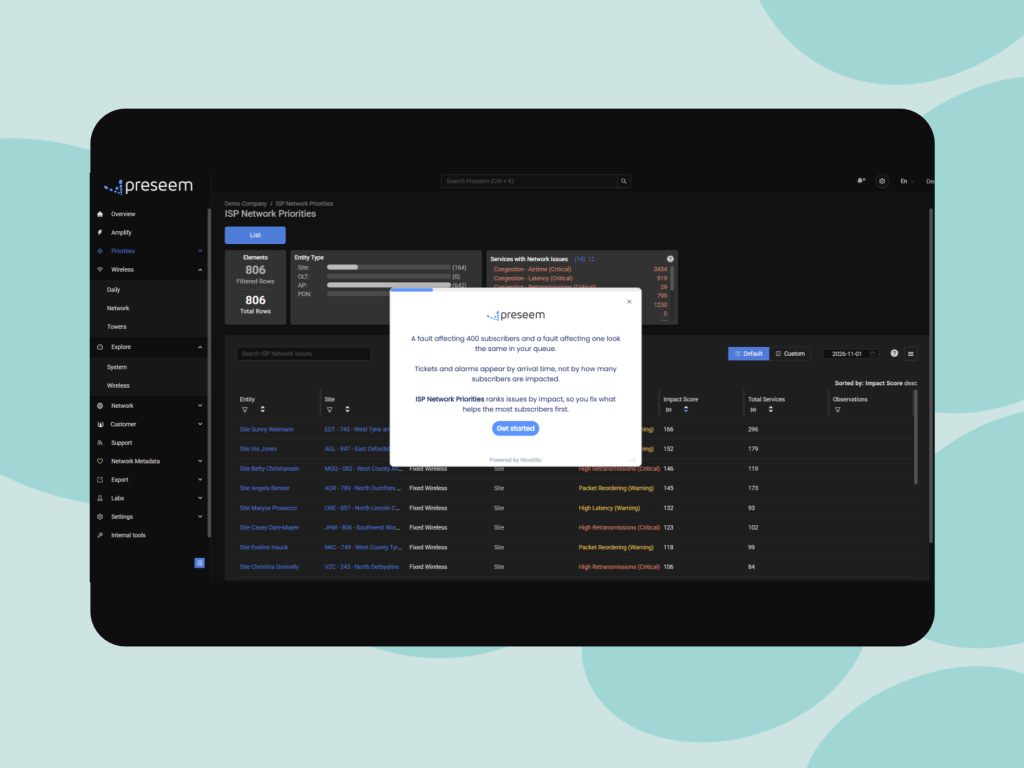
Take A Tour:

ISP Network Priorities

Explore how Network Priorities ranks network issues by subscriber impact, helping you focus on the fixes that make the biggest difference.

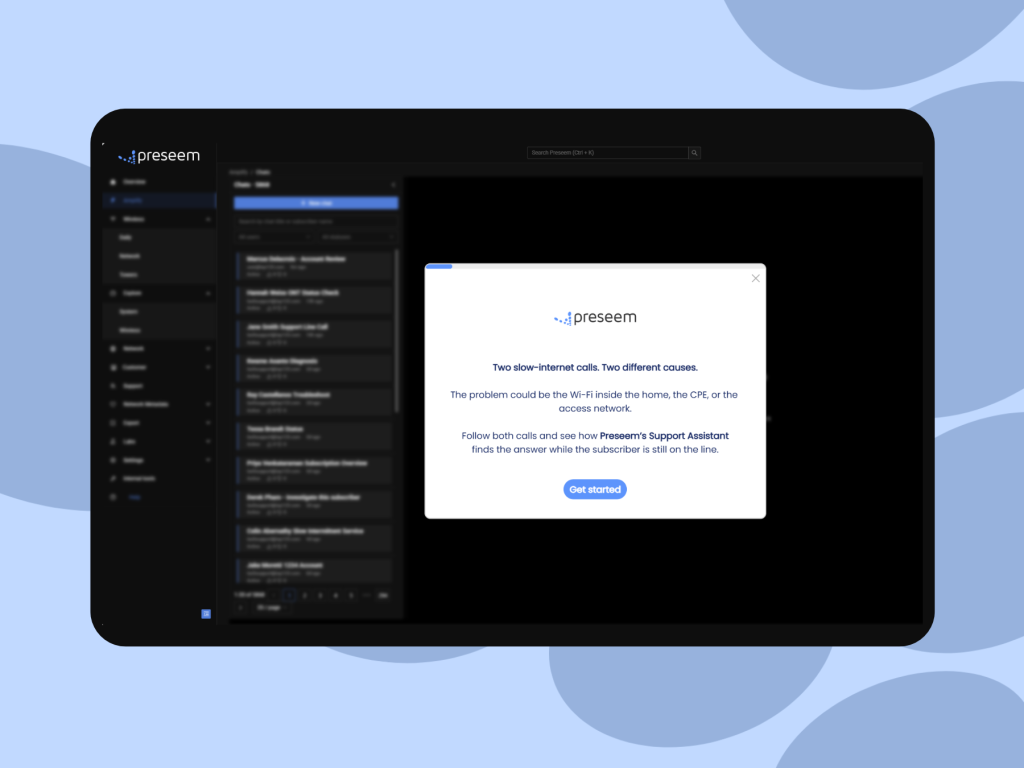
Take A Tour:

Support Assistant

See the Support Assistant in action! 

Frequently Asked Questions


When should a Tier 1 ISP support call escalate?

A call should escalate when the fix needs something Tier 1 can't do: a configuration change on the network, a field repair, or a fault the NOC has to work. An escalation made because nobody could identify the cause in time is the easiest kind to recover, since the information needed to settle it often already exists in the operator's systems. Sort a month of escalations into those two groups and you'll see how much of your Tier 2 load is diagnosis rather than repair. The ISP support performance guide covers the escalation measures that sit alongside it.

Is an AI support assistant for ISPs just a smarter knowledge base?

No. A knowledge base holds procedures that apply to any subscriber, while an assistant connected to network data works out what's wrong with this subscriber's connection today. The knowledge base still has a place, because it's where the steps for a router reset or a plan change live once the cause is known. What it can't do is locate the fault, which is why an agent working from articles alone ends up troubleshooting by elimination.

What does AI agent assist need from a broadband network?

It needs per-subscriber experience measured continuously, a map tying each subscriber to the AP, sector or PON they sit on, access-link telemetry from the radio and OLT vendors you run, and the account's ticket history. To place a problem inside the home rather than just rule out the access link, it also needs evidence from behind the CPE. The topology map is easy to overlook, and without it a tool can't compare a subscriber with their neighbours, which is how a shared fault is told apart from a single one.

What if the subscriber doesn't accept the help desk diagnosis?

Show them the evidence in terms of their own experience: the drops on the evenings they described, or the fact that their neighbours on the same sector saw the same thing. A help desk diagnosis is much easier to accept when it matches what the subscriber lived through, and an agent with the answer already on screen has time to make that connection instead of reading a conclusion off a script.

About Preseem

Preseem shows regional ISPs what every subscriber is actually experiencing, from the network into the home and across every major equipment vendor. Operators use it to improve subscriber experience and business results together: keeping subscribers happier for longer, running a more efficient operation at lower cost, and earning more from upgrades and services subscribers want. Preseem turns that intelligence into next steps for support, the NOC and sales, aimed at whatever helps the most subscribers. Support Assistant gives the rep on the call the cause and the next action in plain language, including whether the fault is in the home or on the network. Network Priorities ranks the sites, APs and PONs to fix first by how many subscribers each one is degrading, and Service Priorities shows which subscribers to contact and whether to fix something or offer an upgrade. Expert view keeps two years of history behind every subscriber, AP and OLT. Learn more at preseem.com.

[/et_pb_post_content][/et_pb_column][/et_pb_row][/et_pb_section]

Latest From Our Blog

Network insights, best practices, and product updates to help you get the most from Preseem.

STOP MANAGING COMPLEXITY

START RUNNING YOUR BUSINESS

Every week without visibility is another week of trucks that didn't need to roll and subscribers who left without telling you why.

Let's start with your network, your vendors, your subscribers.