

Tarana G1 in Action: Introduction
Tarana’s G1 technology brings ISPs a powerful tool for delivering high-speed broadband connectivity to subscribers who didn’t have this option before. Like all vendors, Tarana publishes datasheets that include maximum bitrates.
At Preseem, we collect a lot of data from ISP access networks to help operators move from reactive to proactive operations and make their teams more efficient.
Preseem monitors tens of thousands of Tarana devices across many ISPs, giving us unique insights into performance. We’ve analyzed this large dataset to investigate achievable link rates with Tarana radios in real-world conditions.
This article presents the results of our analysis of link rates for different types of Tarana radios.
Data Analysis Method
A few key points about the methodology used in this study:
- The data used for this analysis comes from a variety of metrics extracted from Tarana radio systems. TCS does not currently display these link rate metrics, but they appear to be valid. In some cases, in particular with four carrier links, we have seen speed tests exceed the estimated link rate.
- Link rates fluctuate over time. For this analysis, we used the 50th percentile link rate over a 24-hour period to represent typical performance.
- To keep the focus clear, these results are based solely on downstream link rates. Upstream link rates are not addressed in this report.
Results
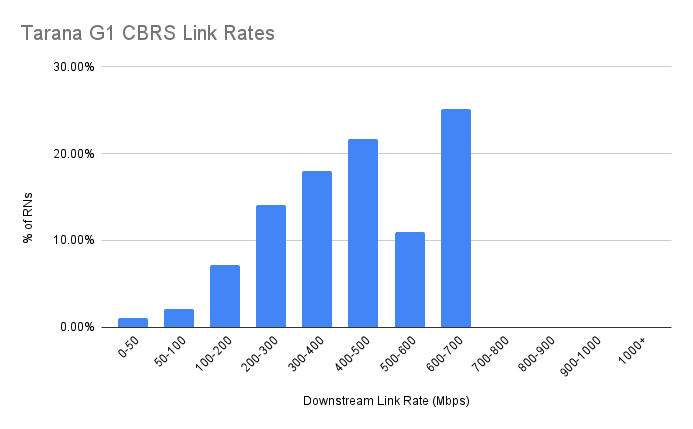
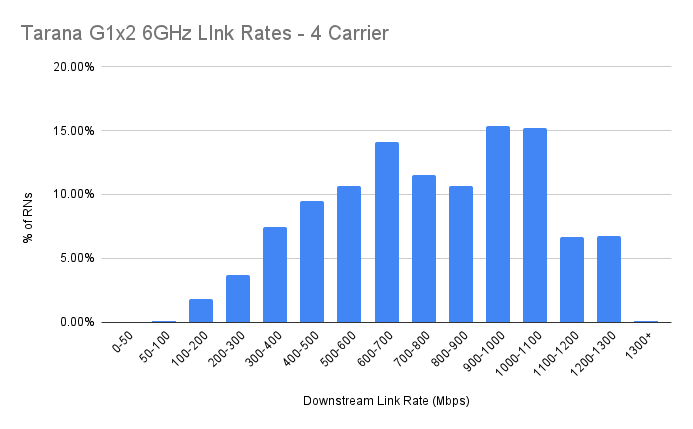
The results of this study are shown in the chart below. For each variant of the Tarana RN radio, we present a histogram of link rates, along with a summary of median and 95th percentile link rates across variants.
| Variant | Median (Mbps) | 95th Percentile (Mbps) |
|---|---|---|
| CBRS | 434 | 641 |
| 5GHz | 307 | 626 |
| 6GHz - 2 carrier | 449 | 522 |
| 6GHz - 4 carrier | 774 | 1223 |


Conclusions
Several conclusions can be drawn from these results:
1. Performance in Ideal Conditions:
- Both the CBRS and 5GHz radios can achieve over 600 Mbps in ideal conditions.
2. CBRS Outperforms 5GHz:
- The typical link rate is higher for CBRS compared to 5GHz. This aligns with expectations, as CBRS bands usually experience less interference and offer better propagation through obstacles due to lower frequencies.
3. Surprising 6GHz Performance:
- The 6GHz radio in two-carrier mode shows lower typical and ideal link rates compared to the 5GHz radio. This could be due to worse propagation at higher frequencies or lower power levels due to Automated Frequency Coordination (AFC); more exploration is needed to fully understand this.
4. Gigabit Speeds with 4 Carriers:
- The 6GHz radio in four-carrier mode can support gigabit speeds under ideal conditions but not typically. ISPs planning to offer gigabit plans with Tarana radios must ensure installations are in optimal conditions with excellent alignment scores to achieve these speeds.
Future Work
This data raises several questions that could guide future analyses:
1. Understanding Low Link Rates:
- What factors contribute to low link rates, and what can be done to improve Tarana deployments?
2. Investigating 6GHz Performance:
- Why do the 6GHz radios achieve a lower link rate per carrier? Could AFC be a contributing factor?
3. Comparisons with Other Technologies:
- How do Tarana link rates compare to other modern FWA infrastructure, such as Wi-Fi 6 and Wi-Fi 7 Access Points?
Send us your feedback: If you have additional ideas for analyzing this data, we’d love to hear from you. Or, if you’re already a Preseem customer, contact us to see how your network stacks up.
See Preseem in Your Network
Don’t have Preseem yet? Want to see this data in your own network? No problem—we can set you up in minutes with a 30-day free trial so you can see it for yourself. All you have to do is schedule a demonstration, and we’ll get the ball rolling!
More on Preseem and Tarana
Our pre-built integration with Tarana’s advanced fixed wireless equipment provides ISPs with unified visibility into detailed subscriber and traffic-based metrics directly linked to the network topology. Learn all about it here.
Take a product tour to review all the charts and metrics for Tarana BNs in Preseem. Also, read our blogs on a) Tower Density and Frequency Reuse in Tarana Deployments, and b) Tarana Connected Clients vs. RF Utilization for more real-world examples of Tarana technology in the field.
Get the Most From Your Tarana Deployment
Download our eBook for exclusive, real-world insights on Tarana G1 performance