

Exploring FWA Deployments by Population Density
As a (now mostly former) wireless ISP operator, I’ve noted that rural, sparsely populated service areas often need subsidies to combat a difficult ROI. Government subsidies are both complicated and controversial. Using Preseem’s dataset of global ISP deployments, I set out to understand how population distribution affects rural and urban FWA deployments and internal subsidies.
Preseem’s ISP operators range over three orders of magnitude in size (the largest are 1,000x the smallest size), so I suspected we would find interesting results in the data.
Site Size
First, I explored what we call FWA sites — typically a vertical structure of some kind, with one or more access points (APs) on them. If we add up all the subscribers served from a given site, we get a classic power law distribution (see sidebar):

We can see that most sites (94%) have 100 subscribers or fewer, and the median (50%) has very few indeed. Let’s rework the horizontal axis to make details at the low end easier to read:
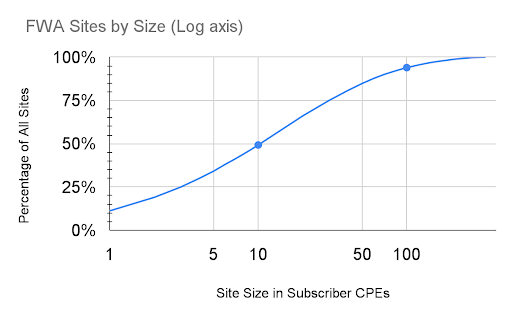
This version makes it easier to see that 25% (!) of all sites have 3 or fewer subscribers. A ‘micro-pop’ or mesh architecture, for example, would have many sites, all of which serve very few subscribers directly. (For the curious, the highest-density site we see has over 1,500 subscribers!)
Subscriber Density
Next, let’s explore how much of the total market is low-density AP deployments.
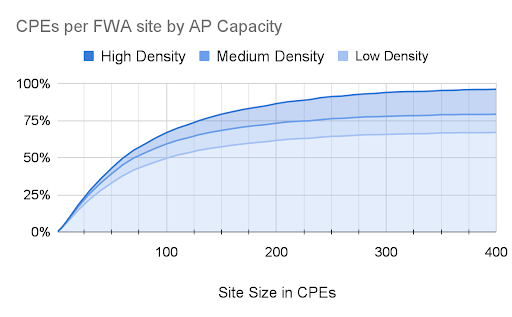
Below 100 subscribers per site, low-density deployments dominate. Here, I’m defining ‘low density’ as an AP model that typically serves 10 or fewer subscribers, ‘medium density’ as 10-15, and ‘high density’ as > 15. For additional insights on this, download our Fixed Wireless Network Report, which shows these models and their typical density.
Looking at this chart, we can see that only 50% of the total market is sites with < 100 subscribers. Compare that to 94% of all sites! This squares with our understanding of the power law.
However, a site can, and often does, have both low- and high-density deployments. A site on the edge of a town, for example, might have a higher density of subscribers on one geographical side than another.
We also note that growth above 100 subscribers per site—about 30% of the total market—is being driven by medium- and high-density deployments. Modern increases in RF efficiency are driving this change, and also enabling a smaller number of APs to serve an equivalent number of subscribers when service is upgraded, for example, to be able to serve faster speed plans.
Rural vs. Urban?
Returning to the start of this journey, can we tell how often ISP operators are ‘internally’ subsidized (i.e., high-density areas that help pay for low-density areas)?
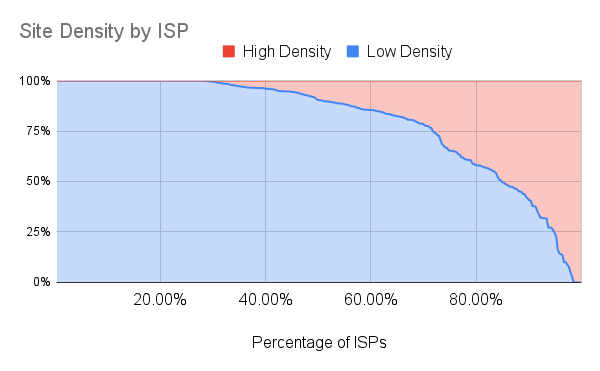
Here, I’ve ordered (ranked) all the ISPs (using FWA) we have data for by the ratio of high- to low-density sites. We can see that nearly 30% of FWA ISPs have no high-density deployments or sites, which implies that they are predominantly rural1. But a surprisingly small percentage of ISPs have no low-density deployments—just a few percent! The rest of the ISPs using FWA have a mix, where at least some percentage of their deployments are high-density.
Finally, let’s look at the same data again—but this time, the horizontal axis is the percentage of the total market, not companies.

This chart is less surprising. Here, we see that a much smaller percentage (<10%) of the market has only low-density deployments. And we can also see that almost no operators have no low-density deployments, and the market is pretty evenly split between “mostly low” and “mostly high.”
The median market, then, has about 25% high-density deployments. This implies that WISP operators provide a vital function—bringing high-speed Internet access to marginal areas. Many of them are doing at least some internal subsidizing, using populated areas to push coverage out into less profitable areas.
As a final note, I also checked to see if there was a relationship between ISP size and ratio of density, and there isn’t a clear correlation. As FWA internet providers expand, merge, and acquire, they don’t appear to be marching toward the cities and higher density—but conversely, they’re also not abandoning cities and towns where they have a good foothold.
- Note that low-density deployments do not directly correlate with low-density populations. As I mentioned above, a mesh-like operation may have a low density of subscribers per AP or site, and may only be sustainable in high population density areas.
↩