From RF Scores to Operations: How Preseem Supports Tarana Networks
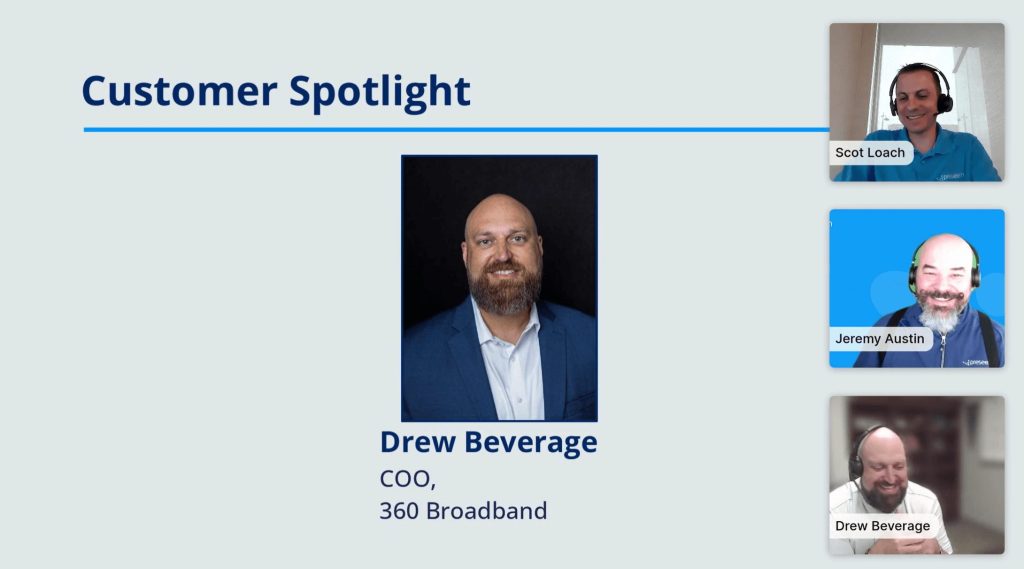
In a recent webinar, Preseem’s co-founder and CTO Scot Loach and Senior Product Manager Jeremy Austin, were joined by Drew Beverage, COO of 360 Broadband, to explore how ISPs can leverage advanced RF analytics to optimize their Tarana deployments and improve overall network operations.
The session demonstrated how Preseem’s unified platform helps regional ISPs move from reactive troubleshooting to proactive network management, reducing support times, identifying churn risks, and uncovering revenue opportunities, all while simplifying operations across multi-vendor environments.
Key Takeaways
For ISPs looking to optimize their operations and network performance:
- Unified visibility is transformative: Multi-vendor networks need a single platform that normalizes data and simplifies operations across all equipment types.
- RF Scores enable proactive management: Rather than waiting for customer complaints, operators can identify and resolve issues before they impact satisfaction and churn.
- Support efficiency improves dramatically: Quick determination of where problems exist (network vs. customer premises) accelerates resolution and improves customer experience.
- Revenue opportunities become visible: Identifying subscribers with excellent RF performance and high utilization reveals natural upgrade candidates.
- Data-driven decisions beat guesswork: From network optimization to capacity planning to installation quality control, having objective metrics leads to better outcomes.
- AI will augment operations: The future involves operators supervising automated workflows rather than executing every task manually.
The Challenge: Data Scattered Across Multiple Systems
Modern ISPs face a common operational headache: critical network insights are fragmented across vendor-specific tools, buried in complex data sets, or simply invisible. This is especially true for operators running multi-vendor networks—a reality for most ISPs as they grow through acquisitions, adopt new technologies, or deploy fiber alongside wireless infrastructure.

Jeremy highlighted the core problem: “In a smaller network, it may be one person who’s done the installs and monitors them after installation. Even in a 10-person company, you might have a very limited set of people that are actually in the RF day after day. In a multi-vendor network, you really are having to jump between a bunch of tools.”
This fragmentation creates several challenges:
- Extended training times for new employees who must learn multiple vendor platforms
- Security concerns from distributing device credentials across many systems
- Inefficient support workflows that require jumping between dashboards to diagnose issues
- Difficulty benchmarking performance across different equipment types
The Solution: Preseem’s Three-Tier Platform
Preseem addresses these challenges through three distinct but integrated feature sets:
1. The Preseem Platform: Single Pane of Glass
At its foundation, Preseem integrates with network devices (access points, OLTs, routers) and billing systems to build a real-time model of network topology. It collects performance data and inventory information, allowing operators to view metrics and historical charts they’d normally need to access through multiple vendor systems.
The impact on operations is significant. Scot shared a compelling real-world example: “One of our largest customers recently told us that by making Preseem the first tool used by their Tier 1 support agents, they were able to reduce their onboarding time for a new support tech from five weeks to two weeks.”
2. QoE Platform: Maximizing Subscriber Experience
The Quality of Experience (QoE) platform sits at the network core, applying active queue management algorithms to customer plans and access points. Beyond making networks feel faster, it measures throughput, latency, and retransmits to identify where problems occur due to overloaded or underperforming network segments.
3. Advanced Fixed Wireless Analytics: Understanding the “Why”
This feature set goes deepest, not just identifying where RF problems exist, but explaining why they’re occurring. It’s designed to make RF expertise accessible to operators at all skill levels.
How Advanced Fixed Wireless Analytics Work
Preseem’s RF scoring system is built on a sophisticated but user-friendly methodology:
Vendor-Agnostic Benchmarking: Rather than relying on proprietary metrics that vary between manufacturers, Preseem uses standardized measurements. As Jeremy explained: “If we look at a Ubiquiti or a Cambium or a Tarana radio, we want to be able to use the same metrics to be able to understand them rather than a proprietary metric.”
Global Network Data: Preseem creates benchmarks using data from customer networks worldwide, providing statistical validity that no single operator could achieve independently. The system compares equipment only against peers with identical configurations—for example, a radio operating at 40 MHz is only compared to other 40 MHz radios.
Simple 0-10 Scoring: All metrics are expressed on an intuitive zero-to-ten scale where ten represents optimal performance. This is further simplified through a four-color system (red, yellow, blue, green) that makes problems immediately visible.
Key RF Scores and Metrics
CPE Radio Level Scores
RF Score: This characterizes how well link rates perform and how stable they are compared to similar equipment. It reveals whether a CPE is operating in a degraded state or is healthy enough to deliver a good quality of experience.
Business Value Score: This combines RF performance with subscriber behavior to assess actual network impact. A subscriber with a poor connection who rarely uses it demands less network attention than a heavy user with similar RF issues. This helps operators prioritize which problems to fix first based on capacity impact.

Access Point Level Scores
AP RF Score: A simple aggregation of all CPE scores under an access point, providing an at-a-glance view of overall AP performance.
AP Health Score: This comprehensive metric combines RF score with several other dimensions, including AP load (whether too many CPEs are attached for optimal performance) and airtime availability (how much capacity remains during peak usage periods).
Jeremy noted that if you’re “down to 50% airtime remaining across an entire day averaged out, that’s pretty critically low. There are going to be times of the day where you absolutely will have more demand than supply.”
Subscriber Capacity: By analyzing airtime availability and peak-hour subscriber behavior, this metric expresses capacity in terms of subscribers, telling operators not just whether an AP is overloaded, but how many more customers it can support. This becomes a powerful tool for sales and marketing decisions in new areas.
Live Demo: Real-World Use Cases
Scot demonstrated these concepts in a live demo, using an anonymized customer network with 12,000 online CPE Radios across multiple vendors, walking through several practical scenarios.
Use Case 1: Proactive Network Operations
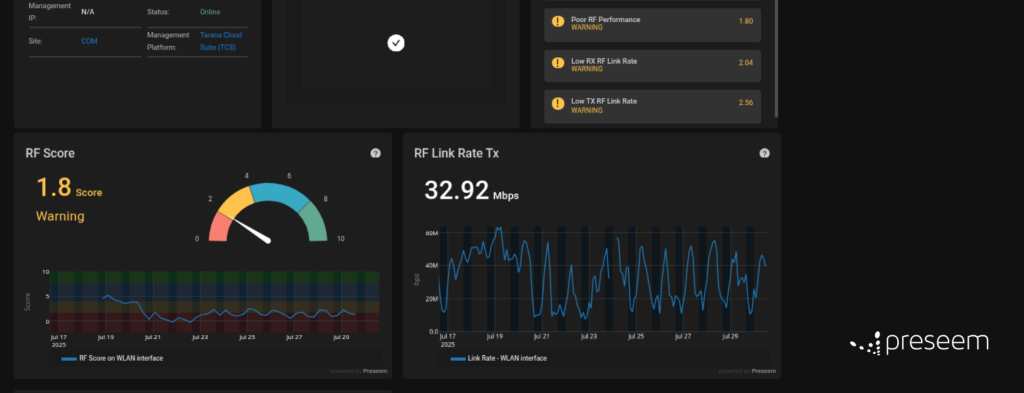
Sorting the network’s CPE Radios by RF score revealed 194 devices in critical condition—potential churn risks requiring attention. Drilling into one troubled Tarana radio showed:
- RF score fluctuating between poor and critical
- Link rates varying wildly between 2 and 30 Mbps
- Subscriber on a 50×10 plan unable to consistently achieve even 25 Mbps
- 80th percentile latency indicating a poor user experience
“That is something that should be proactively addressed for sure,” Scot emphasized. “These could be a churn risk for these subscribers.”
Use Case 2: Installation Quality Control
Another example illustrated how RF scores help catch installation issues. A Tarana RN had been installed on the side of a house to avoid roof penetrations, resulting in:
- Path loss of 143 dB
- Signal-to-noise ratio (SNR) of 17/15
- RF score of -1
- Intermittent service interruptions
After reinstalling on the roof:
- Path loss improved to 126 dB
- SNR jumped to 25/25
- RF score rose to 5-6
- Service stabilized
“This is a story that I got from one of our customers,” Scot explained. “You can see that the RF score was really quite terrible and then got much better.”

Use Case 3: Efficient Support Troubleshooting
A third example demonstrated how RF scores accelerate support resolution. A subscriber experiencing poor latency appeared to have network issues, but looking at their CPE Radio revealed a high RF score.
“In this case we can say, ‘Hey, I believe this customer has a Wi-Fi problem. They do not have a problem with the CPE,'” Jeremy noted. “That’s just as helpful as knowing when you have a problem at the RF layer—knowing when you don’t have a problem at the RF layer.”
This immediate determination allows support to:
- Skip unnecessary network troubleshooting
- Avoid customer frustration from pointless modem resets
- Escalate appropriately when network issues are confirmed
- Focus on the actual problem (in-home Wi-Fi in this case)
“You’re saving generally on the order of many minutes per call instead of having to go dig in and do a lot of sleuthing,” Jeremy added.
Use Case 4: Identifying Upsell Opportunities
The final example showed a subscriber with excellent quality of experience, a high RF score, and who was consistently hitting their 50 Mbps plan limit—a perfect upgrade candidate.
“Some of our customers use our API to pull out these scores and then make that part of the criteria for whether a customer can be sold an upgrade and what they can be upgraded to,” Scot explained.
360 Broadband’s Real-World Experience
Drew Beverage then joined the webinar and shared how 360 Broadband has implemented Preseem’s RF scores across their 1,700 Tarana RNs.
Establishing Baselines: “Once we get an installation completed, say we had a successful install, like you guys mentioned, QC-ing that install, everything looked good,” said Drew. “Three, four weeks later down the road, that RF score is starting to drop, and now we’re seeing that they’re not able to reach their plan. Are we going to send a truck to make sure they’re achieving that so they’re not having poor service?”
Bidirectional Value: The scores help in two ways: qualifying that customers receive what they’re paying for, and identifying customers with headroom who could benefit from upgrades. “You can use that data both directions,” Drew noted.
Impressive Capacity: 360 Broadband is pushing Tarana’s capabilities with 147 and 150 subscribers on individual BNs without capacity issues. “We haven’t hit capacity on any of our BNs,” Drew reported. “We’re not seeing it through our RF scores based on the capacity side of it yet.”
Testing Changes with Confidence: When 360 switched some deployments from profile one to profile two (changing the downstream/upstream ratio), they used RF scores to verify the change didn’t degrade customer experience.
Multi-Vendor Management:“Being able to have multi-vendor into a platform, being able to pull this up and be able to see everything throughout the network—it’s a big thing,” Drew emphasized, echoing the single-pane-of-glass benefit Scot had highlighted.
Lower Churn and Support Volume: While still gathering comprehensive data, Drew noted: “Our churn rate is lower on Tarana and our phone call volume is lower on Tarana” compared to legacy platforms.
Looking Ahead: Tarana G2 and AI
The webinar also included a look at how Preseem will adapt its RF scoring for Tarana’s new G2 platform, as well as the potential for AI to transform support and operations for ISPs.
As an example, Scot shared that customers are already using Preseem’s API to pull RF scores when subscribers call and, if it’s a poor score, “that IVR (Interactive Voice Response) doesn’t even go to a Level 1 support agent. That immediately brings them right up to Level 2 because we know there’s a real problem.”
The role of any employee of an ISP is going to evolve “from a world where you’re doing the work to a world where you’re supervising the work that’s being done by automation,” Scot predicted.
See Preseem in Your Network
Preseem offers a free 30-day trial requiring only a VM to run our poller—no additional equipment is needed to access the platform and advanced fixed wireless analytics (the QoE platform does require network equipment).
For ISPs struggling with fragmented tools, extended support calls, or uncertainty about network performance, Preseem’s approach to RF analytics offers a path to more efficient operations and better customer experiences.