

A Small Study of DSCP Usage at US Regional ISPs
The IP Differentiated Services Codepoint (DSCP) field (RFC 2474) is a mechanism that enables traffic to be treated differently by the network. This mechanism has seen little adoption on the public Internet due to coordination problems across providers.
The recent IETF Non-Queue-Building (NQB) (IETF draft) effort aims to be the first widely deployed interdomain DS codepoint. This development triggered us to investigate the prevalence of DSCP marking in regional ISPs, with an eye for opportunities to improve the subscriber experience.
Our small study was presented at the Understanding Latency 3.0 conference last December. The YouTube link is below (scroll to the 1:51:26 mark for the start of our presentation). The conference also included discussions on NQB.
Please watch the talk for all the details. Here’s a quick summary:
- We looked at DSCP usage across six ISPs, morning and afternoon, and upstream and downstream.
- The vast majority of traffic was marked with DSCP 0 (no mark).
- The distribution of DSCP value usage for the non-0 traffic varied significantly across the six providers.
- Traffic in the afternoon has slightly more DSCP 0 traffic than in the evening.
- Upstream traffic has a more consistent DSCP distribution than downstream traffic.
The traffic distribution by DSCP mark charts was particularly fun to build and present.
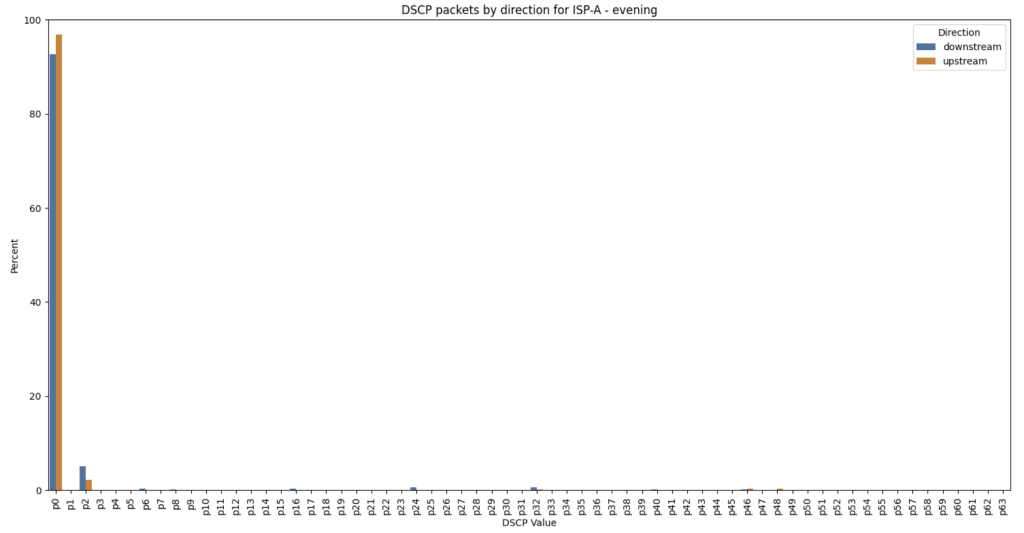
At this point, the data suggests that DSCP classification has a very limited role within ISP Regional ISP networks. Here’s hoping that NQB changes this in the future.