
Introduction
Tarana’s G1 technology brings regional ISPs a powerful tool for delivering high-speed broadband connectivity to subscribers that did not have this option before. However, deployment choices—such as the number of sectors per tower and frequency reuse patterns—can impact the cost of deployments and network performance. This article explores how deployment strategies align with Tarana’s recommendations, helping operators assess if they’re maximizing both efficiency and cost-effectiveness.
Tarana’s Recommendations for Tower Density and Frequency Reuse
Tarana’s deployment guidelines provide advice for balancing coverage, performance, and cost:
- Sector Count: Tarana suggests a three-sector setup for most towers, reserving four-sector configurations for highly utilized sites. This helps control costs by avoiding over-provisioning in low-demand areas.
- Frequency Reuse: Tarana’s universal frequency reuse (k=1) approach can streamline planning but may introduce interference. Tarana advises using k=2 (two unique frequency sets) for dense deployments to maintain performance without additional cost in interference management. Tarana also suggests using k=1 for a three-sector cell and k=2 for a four-sector cell.
By following these guidelines, operators can aim for efficient setups that meet subscriber needs without incurring unnecessary expenses.
Finding #1
Four-Sector Configurations Are Prevalent But Are They Necessary?
The following chart shows a breakdown of how many sectors are deployed on a tower, across the thousands of BNs managed by Preseem.
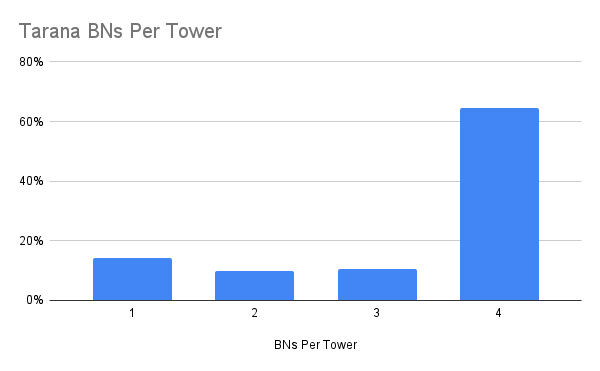
This data reveals that most Tarana deployments opt for a four-sector configuration per tower, a choice that increases both equipment and operational costs. According to Tarana, a four-sector setup is best reserved for high-utilization towers. So, are these towers highly utilized? The following chart shows the average 95th percentile RF utilization for each cohort.

This chart implies that in general, four-sector deployments do not seem to be driven by RF utilization: if this were the case, we would expect to see a much higher utilization by the BNs on the four-sector towers. This raises questions about whether the same coverage and performance could be achieved with three sectors, at a reduced cost.
Finding #2
Frequency Reuse Patterns: Maximizing Spectral Efficiency and Cost
Another factor in cost-effective deployment is frequency reuse. While universal reuse (k=1) simplifies frequency planning, operators should assess its long-term cost-effectiveness. Overlapping frequencies across sectors can increase interference. This impacts performance and, potentially, subscriber satisfaction.
The following chart shows our analysis of frequency reuse across the cohorts. The Y-axis shows the percentage of towers that share the same frequencies across all BNs on the tower.

This shows that even in four-sector towers, k=1 frequency reuse is fairly common despite Tarana’s recommendations to use k=2 for maximum performance. If enough clean spectrum is available, using a k=2 pattern on these towers may enable a higher performance deployment that will scale better as more subscribers are added over time.
Conclusion
While Tarana’s G1 technology offers flexibility, operators can benefit by optimizing deployments not only for network performance but also for cost efficiency. Our data shows that many deployments are likely over-provisioned, highlighting an opportunity for operators to achieve the best bang for their buck by aligning their setups with actual demand. Specifically, the coverage benefits for a four-BN deployment may not outweigh the cost in most cases.
By strategically managing sector density and frequency reuse, operators can achieve the dual goals of high performance and cost savings, ensuring long-term sustainability and customer satisfaction.